Потрібна допомога адвоката?
Залишай заявку
AMCU fines businesses more than UAH 133 million for bid rigging
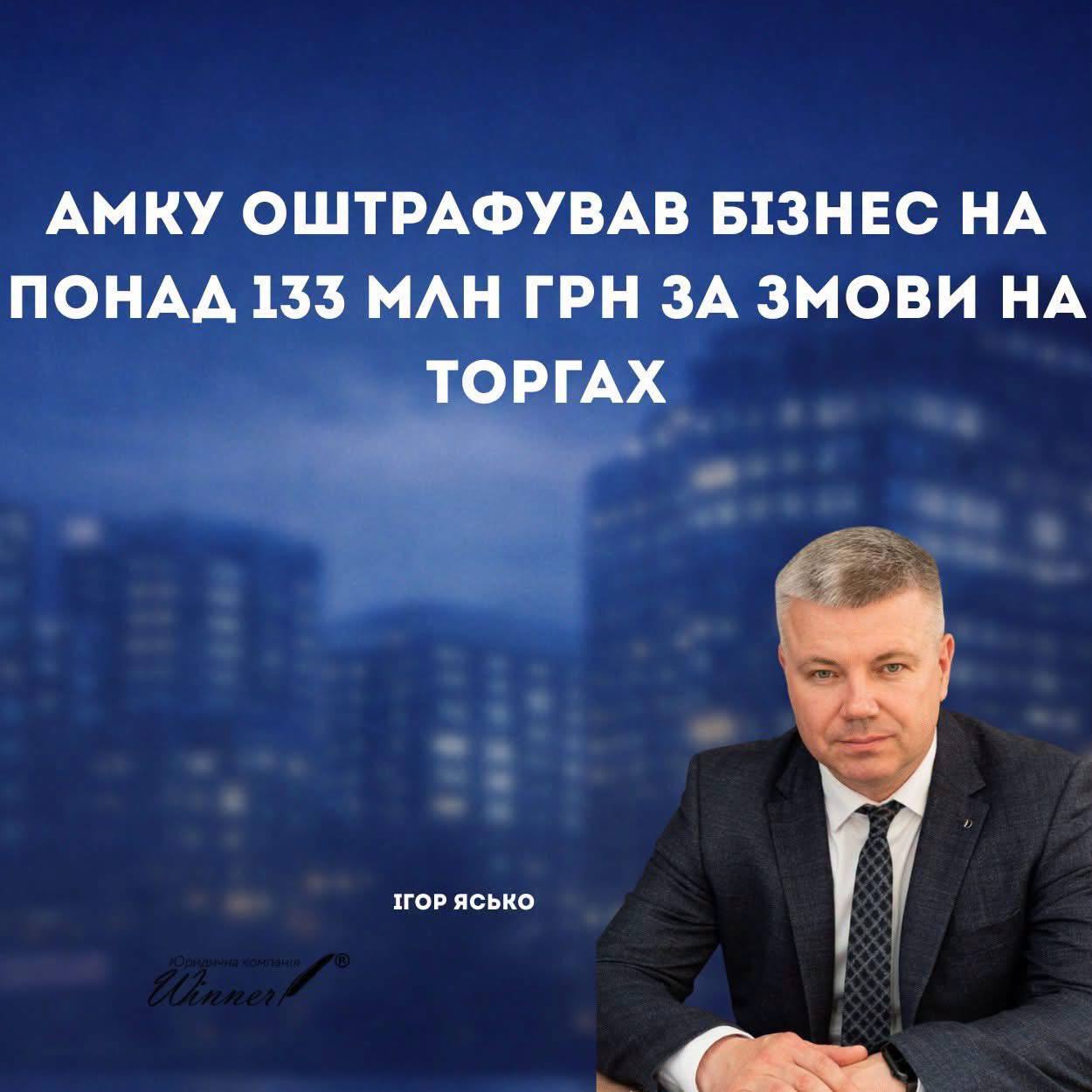
One day brought six decisions by the Antimonopoly Committee of Ukraine (AMCU) and more than UAH 133 million in fines for businesses.
On 8 September, the AMCU announced the outcomes of several cases involving anti-competitive concerted practices during tenders and auctions.
The largest fine, UAH 110 million, was imposed on two companies for five violations in electricity-supply tenders. The expected value of these procurements exceeded UAH 1.5 billion.
However, this was far from the only case.
The AMCU also found violations in:
- the procurement of electricity meters for an energy company;
- 11 cable-product procurement tenders;
- the privatisation of an alcohol-production business;
- the sale of an integrated property complex of a state-owned enterprise;
- a land auction.
In several cases, the participants themselves admitted that competition law had been violated.
What does this mean for business?
Bid rigging is not necessarily a situation in which two directors meet and sign a written agreement on who will win.
The AMCU assesses the totality of circumstances and facts that may indicate coordinated conduct by participants and the effective elimination of competition.
Therefore, seemingly ordinary links between participants can create risks for businesses, including:
- shared or former employees;
- commercial and financial relationships;
- identical or similar documents;
- shared communication tools or technical infrastructure;
- unusual conduct during the tender;
- information exchange between participants;
- other facts that the AMCU may collectively view as coordination.
A fine is not the only risk.
If a company is held liable for anti-competitive concerted practices that distort tender results, it may be excluded from participation in public procurement procedures for three years.
For a company that receives a significant share of its revenue from public procurement, the consequences of such a decision may be much more costly than the fine itself.
Therefore, before related companies—or even companies that are simply acquainted with one another—participate in the same tender, they should assess more than just the tender documentation.
The review should be broader: who the owners are → who the employees are → what payments exist between the companies → how the documents are prepared → who has access to information → how participants behave during the auction.
What may appear to a business owner as ordinary commercial interaction can, together with other evidence, become an argument for the AMCU in a case concerning anti-competitive concerted practices.
Today, the cost of this risk is measured not in thousands, but in tens of millions of hryvnias, as well as the ability to continue operating in the public-procurement market.
It is better to seek legal advice now than to require legal representation later.
Would you like to assess your company’s tender risks, or do you need representation in an AMCU case concerning anti-competitive concerted practices?
📞 Call: 096 574 81 02
📧 Email: info@uk-winner.com
Author: Ihor Yasko, Managing Partner at WINNER Law Firm, PhD in Law.
Потрібна допомога адвоката?
Залишай заявку

- Усі права захищені