Потрібна допомога адвоката?
Залишай заявку
Mass unlawful refusals by state authorities, banks and mobile operators to provide information
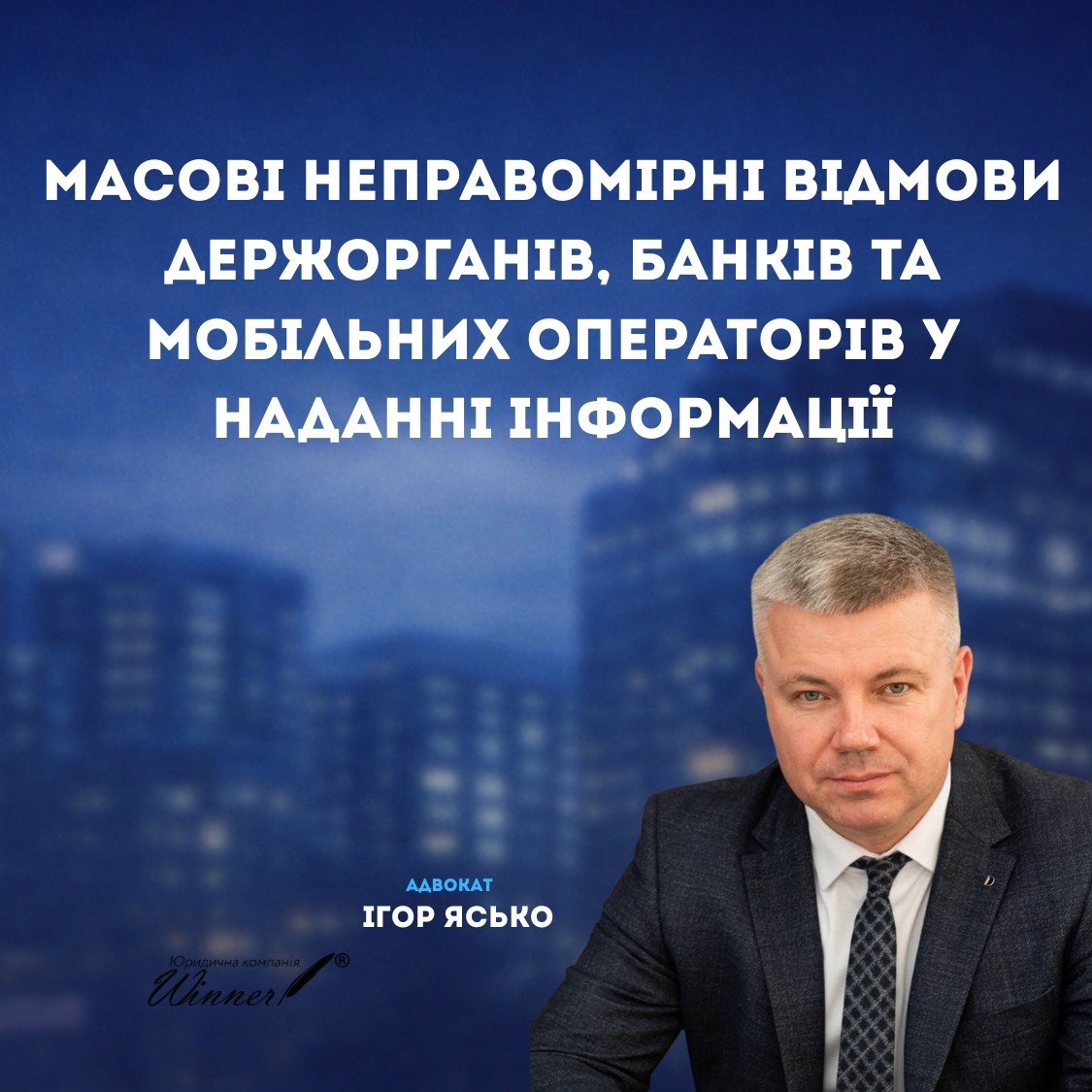
In recent years, lawyers and businesses have increasingly faced situations where public authorities, banks and mobile operators systematically refuse to provide information. Formal references to “personal data protection”, “bank secrecy” or “lack of authority on the part of the requester” often conceal an unwillingness or inability to perform basic duties. The sheer scale of such refusals turns them from an exception into a routine practice, undermining legal certainty, making it impossible to protect the rights of citizens and businesses and creating additional risks for investigative bodies, lawyers and courts.
Reasons for widespread refusals to provide information
The core problem lies in a combination of three factors. First, the complexity and fragmentation of regulation: the right of access to public information, bank secrecy, personal‑data protection, confidentiality of communications and procedural rules exist in parallel, and their conflicts are often resolved “in favour of silence” — i.e. by refusing access. Second, fear of sanctions: bank and operator staff are afraid of liability for unlawful disclosure and therefore automatically choose the most conservative option — to provide nothing without obvious and indisputable legal justification. Third, a low service culture and reluctance to take responsibility: it is easier to send a template refusal than to deal with the specifics of a particular request.
In public authorities, an additional factor is the inertia of “closedness”: officials often perceive any request as a threat or additional burden rather than as a tool for implementing citizens’ rights. As a result, even clearly lawful requests by lawyers, notaries, businesses or journalists are met with formal boilerplate replies or silent refusals.
Types of information most frequently refused
Three blocks of information are particularly vulnerable. The first is financial data: banks often refuse to provide statements, information on cash flows or account balances, citing bank secrecy even where the requester has an obvious procedural status (an investigator with a court order, an insolvency practitioner, a lawyer with a mandate) or the client’s explicit consent. The second block is telecom data: call records, SIM‑card linkage, subscriber registration data, geolocation. Here the classic arguments are “confidentiality of communications” and “personal‑data protection”, even where the law clearly permits access based on a court order or the subscriber’s consent.
The third block is information stored in state registers and information systems: data on assets, corporate rights, administrative acts, inspection results, enforcement proceedings and so on. Even where there is a legitimate interest and clear references to sector‑specific laws, requesters are told that “the information is restricted/contains personal data”, without any further analysis of whether partial or anonymised disclosure would be possible.
Formal grounds vs real motives for refusal
A typical pattern is the use of lawful grounds in a distorted or overly broad interpretation. For example, provisions on bank secrecy or personal data are applied without regard to exceptions such as the subject’s consent, the existence of a court order, the requester’s procedural status or an explicit rule in a special law. Authorities and institutions often “overlook” the fact that restrictions on access must be proportionate and justified, not absolute.
The real motives behind refusals frequently include a reluctance to expose problematic transactions, corruption risks or simple avoidance of responsibility: providing information may reveal weaknesses in internal procedures, legal violations or official negligence. Another factor is that certain departments are overloaded; processing requests takes time and resources they lack, so refusals become a way to reduce workload.
Consequences for the rights of citizens and businesses
Systemic unlawful refusals to provide information affect several levels. For citizens, they mean an inability to effectively protect their rights: to challenge decisions, prove violations and collect evidence for courts or law‑enforcement bodies. For businesses, they complicate compliance and risk management: it becomes impossible to detect fraud in time, confirm contract performance, conduct internal investigations or respond to suspicious transactions.
For law‑enforcement and justice systems as a whole, the result is the devaluation of legal mechanisms: investigations drag on, courts lack evidence and lawyers are forced to rely on indirect methods of obtaining information (through third parties, informal contacts or parallel requests). In the long run, this undermines trust in state institutions, the financial system and the telecom market, as participants see that formally guaranteed rights of access to information do not work in practice.
Procedural tools to counter refusals
The key response to mass refusals must be systematic use of procedural tools. For public authorities, this includes challenging their responses (or inaction) before administrative courts, filing complaints with higher‑level bodies and the ombudsman, and invoking liability mechanisms for officials who unjustifiably restrict access to information. Case law is gradually developing standards: authorities must clearly explain why particular information cannot be disclosed and why partial access or anonymisation has not been applied.
With respect to banks and mobile operators, an effective approach combines civil‑law, banking and procedural instruments: documenting requests and refusals, appealing to regulators and supervisory bodies, and using court proceedings, including motions for the court to compel disclosure of evidence. It is important not to stop at a single exchange of correspondence but to build an evidentiary trail showing that the institution is deliberately blocking access to information it is legally obliged to provide.
Role of lawyers and compliance professionals
Lawyers and in‑house counsel play a central role in combating unlawful refusals. They must not only draft legally sound requests but also design an overall strategy in advance: identify alternative sources of evidence, choose appropriate judicial or regulatory mechanisms and assess the risks of conflict with a particular institution. For banks and operators, in turn, it is crucial to develop internal policies that balance confidentiality with compliance with lawful requests: clear procedures for verifying requesters, quality control of responses and staff training.
In the corporate sector, unlawful refusals by counterparties and service providers should be taken into account when assessing partners: persistent opacity may signal heightened legal and reputational risks. Lawyers may recommend including contractual clauses on information provision, audit access and cooperation obligations in case of investigations.
Need to change practice and access culture
The scale of unlawful refusals reflects not only regulatory problems but also a lack of transparency culture. A shift in mindset is required: from “everything is prohibited unless explicitly allowed” to “everything is allowed unless prohibited, provided that interests are balanced”. Public authorities should treat information requests as a normal part of their work, and banks and operators should regard them as an element of client service and compliance rather than as a threat.
This calls for legislative changes (clarifying conflicts of law, strengthening liability for unjustified refusals), development of self‑regulatory practices and awareness‑raising among staff. Otherwise, the right of access to information will remain a declaration that collapses when confronted with day‑to‑day administrative reality.
If you have any questions or issues related to unlawful refusals by public authorities, banks or mobile operators to provide information, please contact our lawyers for individual advice and professional legal assistance.
Author: Ihor Yasko, Managing Partner of JSC “Law Firm WINNER”, PhD in Law.
Потрібна допомога адвоката?
Залишай заявку

- Усі права захищені