Потрібна допомога адвоката?
Залишай заявку
Updated CRS from 2027: more data on foreign accounts and digital assets
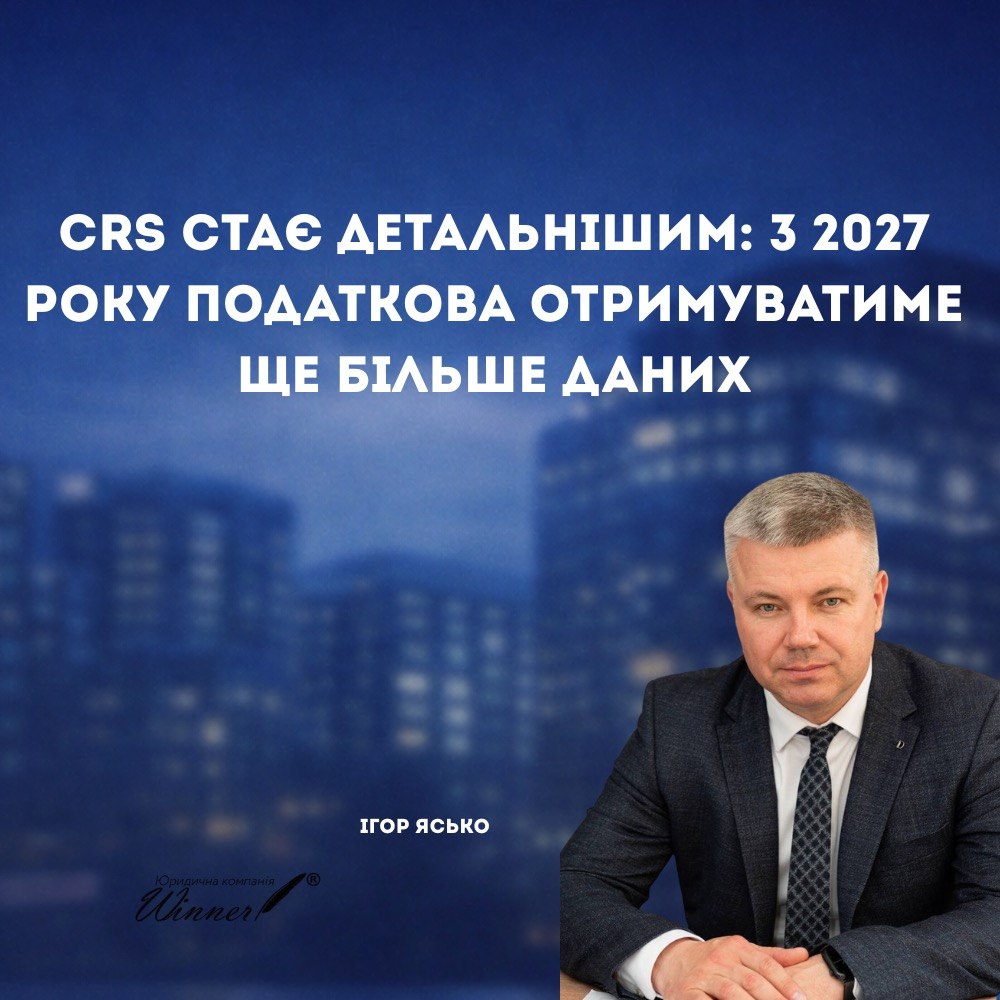
The international automatic exchange of tax information is moving to the next level.
On 4 September, the State Tax Service of Ukraine reported that the OECD had updated the technical standard for exchanging information under CRS by introducing the new CRS XML Schema v3.0.
The transition is planned for 2027.
At first glance, this may appear to be merely a technical update to the data-transmission format between tax authorities.
However, for owners of foreign accounts, companies, and international structures, the implications are much broader.
The new schema provides for additional information fields in reports on reportable financial accounts.
In practical terms, international automatic exchange is becoming more detailed.
The CRS update is linked to amendments to the international standard itself, developed by the OECD and supported by the G20.
Among other things, the updated CRS expands the coverage of modern financial instruments and strengthens reporting and customer due-diligence requirements for financial institutions.
The scope of the updated standard includes certain electronic money products and central bank digital currencies.
CRS also covers indirect investments in crypto-assets through derivatives and investment structures.
At the same time, a separate international mechanism — CARF (Crypto-Asset Reporting Framework) — is being developed for direct transactions involving crypto-assets.
In other words, the global system is gradually moving toward a model in which tax authorities receive increasingly structured information not only on traditional bank accounts, but also on modern financial and digital assets.
Ukraine is already working on the relevant amendments to its national CRS reporting procedures.
This is particularly important for Ukrainian tax residents.
CRS is not a tax and does not result in an automatic tax assessment.
The fact that the State Tax Service receives information about a foreign account does not, by itself, mean that a violation has occurred.
However, this data may be used to compare it with the information a taxpayer declares in Ukraine.
This may raise questions regarding:
– tax residency;
– foreign-source income;
– asset ownership structures;
– controlled foreign companies;
– sources of funds;
– declared income and taxes paid;
– consistency of information across different jurisdictions.
Therefore, owners of foreign accounts, companies, and CFCs should gradually move away from asking:
“Will the State Tax Service see it?”
and focus on the more important question:
“Does what the State Tax Service sees abroad correspond to what I declare in Ukraine?”
As CRS and the future CARF develop, this consistency is becoming one of the key elements of international tax security.
You can seek legal advice now rather than need legal representation later.
Would you like to receive legal advice regarding CRS, CFCs, foreign accounts, or the taxation of digital assets?
📞 Call: 096 574 81 02
📧 Email: info@uk-winner.com
Author: Ihor Yasko, Managing Partner at WINNER Law Firm, PhD in Law.
Потрібна допомога адвоката?
Залишай заявку

- Усі права захищені