Author name: admin

Без рубрики

Tax Audit Schedule 2026: Who Was Affected by the March Update

Потрібна допомога адвоката? Залишай заявку On 26 March 2026, the State Tax Service published an updated schedule of documentary audits, which in practice is one of the key indicators of tax risk for businesses. It is not just a “list of the unlucky”, but a snapshot of the sectors, transactions and behaviour patterns that the tax authorities currently regard as the most risky, so reading the schedule correctly helps companies and sole proprietors both assess their chances of an inspection and understand the overall logic of control in 2026. What the audit schedule is and how it is updatedThe schedule of documentary audits is an official list of taxpayers the STS plans to audit during the year, compiled according to risk criteria and periodically updated as a “roadmap” for control. The update of 26 March 2026 is no longer the initial version but a revised list that takes into account new data, returns and previous audit results, so a business that was absent from the January version may well appear in the updated list now. Trends to expect in the updateAlthough the specific lists of taxpayers depend on information‑system data, the STS’s general focus areas are usually predictable. In the 2026 schedule we can reasonably expect a stronger focus on: sectors with a high share of cash payments – retail, HoReCa and household services, where cash registers, chains of sole proprietors and “grey” turnover remain sensitive issues; participants in risky VAT chains – companies that show up in analytical cross‑checks related to blocked tax invoices, “carousel” schemes, imports with overstated/understated values or purely formal exports; exporters and importers with atypical indicators – for example, low profitability with large volumes, or mismatches between customs and tax data; companies with complex group structures – particularly where there are risks of business splitting among several sole proprietors and legal entities, artificial profit shifting or under‑declared VAT. A separate group consists of taxpayers that have already been subject to unscheduled actions, additional assessments or invoice blocking. For the STS, such cases are a signal to “dig deeper”, so they more often end up in the annual plan. How to check whether your company is on the listFormally it is simple: the schedule is published in open access, and a taxpayer can check their EDRPOU/Tax ID code in the relevant sections. In practice, businesses often perform a single check at the beginning of the year and miss spring or summer updates when they may already have been added. Therefore, in 2026 it is advisable to monitor the schedule regularly, at least after each official update. If you find yourself in the schedule, you should look at: the type of audit (planned documentary audit, VAT‑only or covering other taxes as well); the period to be audited; the approximate start date of the audit. This information gives you time to review your reporting, turnovers, primary documents and internal policies before the inspectors arrive “on site”. What inclusion in the schedule means for real risksBeing listed in the schedule does not guarantee that an audit will take place on the exact stated date, but it is a clear signal that your business has been classified as higher risk. It usually implies greater attention from analytical departments to your transactions, a higher probability of additional information requests and cross‑checks, and a wider range of issues during the audit (from corporate income tax to VAT, personal income tax, social contributions, transfer pricing and the reality of transactions). For management, this is not a “sentence” but it is also not a mere formality: it is cheaper to conduct an internal audit in advance than to respond in crisis mode to audit reports with additional assessments. How to prepare for an audit under the updated scheduleThe preparation algorithm depends on the size of the business, but the basic steps are similar: Analyse risk areas. Assess which taxes, periods and transactions are likely to attract inspectors’ attention. If you have had blocked invoices, unusual transactions with non‑residents, high payments to sole proprietors or large losses, these areas should be reviewed first. Check the completeness of primary documents. Review contracts, acts, invoices, CMR/waybills, internal orders and policies. Pay special attention to complex or “non‑standard” deals, transactions with related parties and counterparties from the “grey‑risk zone”. Assess potentially contentious positions. Where transactions have ambiguous tax treatment (business purpose, reality of services, expense classification, VAT credits), prepare your arguments, legal references, individual tax rulings or court practice in advance. Set internal procedures and responsibilities. Decide who will communicate with inspectors, how requests will be registered, how quickly responses will be prepared, and who makes decisions on admitting/denying entry, appealing findings, etc. Consider preventive steps. Sometimes it is reasonable to correct specific errors via amended returns or voluntary top‑up payments before the audit starts, which reduces penalties and simplifies negotiations with the STS. What businesses should focus on in 2026The updated 2026 schedule should be viewed in a broader context. The STS continues to rely on analytical taxpayer selection based on electronic data and focuses on businesses’ historical behaviour – indicator dynamics, participation in risky chains and reaction to past comments. This means that: one‑off “cosmetic” adjustments in accounting will no longer hide systemic issues – trends over several years are visible; companies with aggressive tax models (large chains of sole proprietors, unusual compensations, quasi‑dividends) will increasingly fall within the scope of not only unscheduled actions but also annual audits; compliant businesses that respond to comments in a timely manner, adjust risky practices and communicate transparently with the tax service are more likely either to avoid the schedule altogether or to pass audits with minimal consequences. In these circumstances, the schedule becomes not only a control tool but also a kind of “feedback” from the state. If your business appears in the updated list as of 26 March 2026, this is a signal that the tax service already views certain aspects of your activity as risky, and the earlier you address them, the lower the chances

Без рубрики

Tax Service vs. Simplified Taxpayers: Is Every Third Sole Proprietor a “Schemer”?

Потрібна допомога адвоката? Залишай заявку In recent years, the tax authorities have increasingly spoken about “massive abuse of the simplified tax regime” and business splitting schemes, where instead of one taxpayer there appears a chain of formally independent sole proprietors or small companies on the simplified system. In public rhetoric, we often hear that “every third” single tax payer is not a small business, but a “mask” for a large one, which leads to more audits and analytical checks. The problem of artificial splitting is real, but this blanket suspicion of “every third” also hits bona fide businesses that simply use a legal regime, and as a result the tax service risks losing the trust of the very small businesses the state claims to prioritize. What “schematic splitting” means for the tax authoritiesBy splitting, tax officials usually mean situations where:· a large business deliberately divides its activity among several sole proprietors or small companies in order to stay within the limits of the simplified regime;· related companies in fact operate as a single business structure (shared management, staff, one brand and infrastructure), but formally present themselves as many separate “small” entities;· a chain of simplified‑regime entities is used to bypass rate or activity restrictions, with each of them performing only part of the operations. The economic effect is obvious: instead of paying corporate income tax, VAT and social contributions in full, the business operates under low single‑tax rates and significantly reduces its tax burden. For the tax authorities this means lost revenue and “unfair competition” towards those who work transparently under the general system. Why almost everything looks suspiciousThe issue is that the signs of “bad” splitting often overlap with the features of a normal modern business structure. For the analytical units of the tax service, the following may act as triggers:· the same owner/manager in several sole proprietors or companies;· shared address, website, phone number or brand;· sales concentrated on one or two major customers;· repeated transactions of the same type with the same counterparties. Modern small business often looks exactly like this: one entrepreneur runs several lines through different sole proprietors, freelancers work under a common brand, and service companies cooperate around one large client. These signs by themselves do not prove abuse, but within the logic of “every third is under suspicion” the tax service tends to see them as elements of a scheme. The risk of such mass suspicion is a shift away from the presumption of good faith: instead of having to prove that operations are artificial, the state effectively expects the business to justify why it has several sole proprietors and has not merged into a single company. Weaknesses of the fiscal approach· Focusing on slogans like “every third simplified taxpayer is a schemer” works well in the media space but poorly in real administration.· There are no clear legal criteria for splitting: the law does not prohibit having several sole proprietors or companies, and everything rests on value‑based notions, which leaves room for subjectivity.· Small business overload: instead of targeting large schemes, the tax service spends resources on mass “screenings” of small taxpayers with minimal fiscal effect.· Reputational damage: labelling all simplified taxpayers creates an image of the tax service as an enemy, encouraging not dialogue and voluntary compliance, but the search for new and more sophisticated schemes. Why businesses choose multi‑entity structuresIt is important to admit that part of the splitting is a reaction to the tax system itself. When:· the general tax system implies significantly higher rates and more complex administration;· single‑tax thresholds are strict and limits fail to keep up with inflation and real business growth;· the rules of the game keep changing and the risk of additional assessments is high; business naturally looks for legal (and semi‑legal) ways to minimise the burden. In many cases, the decision to “spread activities across several entities” arises not from a desire to “cheat the state at any cost”, but as a way to survive amid instability and high formal taxes. For small and medium‑sized businesses, this is also a risk‑management tool: if one link “goes negative” or falls under sanctions/blocking, the others formally remain operational. What the state could do instead of mass suspicionIf the goal is not just to “squeeze” part of simplified taxpayers but to genuinely reduce the incentive to split, the state must change its approach. Possible steps: Introduce transparent risk criteria: publicly define which combinations of indicators (related owners, lack of economic rationale for separation, purely nominal functions) the tax service will treat as signs of artificial splitting. Revise the parameters of the simplified regime: adjust limits, rates and restrictions to market realities and offer more flexible models to reduce the incentive for technical splitting. Focus on targeted rather than mass campaigns: work with sectors where abuse is most widespread, collect evidence and build strong, illustrative cases instead of general slogans. Communicate without stigmatisation: explain what a correct and safe multi‑entity business structure looks like, so compliant taxpayers understand the boundaries of what is allowed. What entrepreneurs should do nowIn a reality where the tax service suspects “every third” simplified taxpayer, any such business, especially one with a group of related sole proprietors/companies, should prepare in advance:· analyse the structure: who is the formal owner, where counterparties overlap, how the “chain” looks from a tax inspector’s perspective;· record the economic rationale: why the business is structured this way (separate business lines, different risks, different partners, etc.);· put records in order: document flow, contracts and primary documents, so you can demonstrate the reality of operations if needed;· assess whether it might be simpler to partially exit the split structure (merge some entities, change the regime) than to constantly operate in a high‑risk zone. It is essential to remember that even if a business has no intention of evading taxes, the mere existence of several related simplified‑regime entities can attract the tax service’s attention. It is better to have a clear story, documents and a thought‑out position by the

Без рубрики

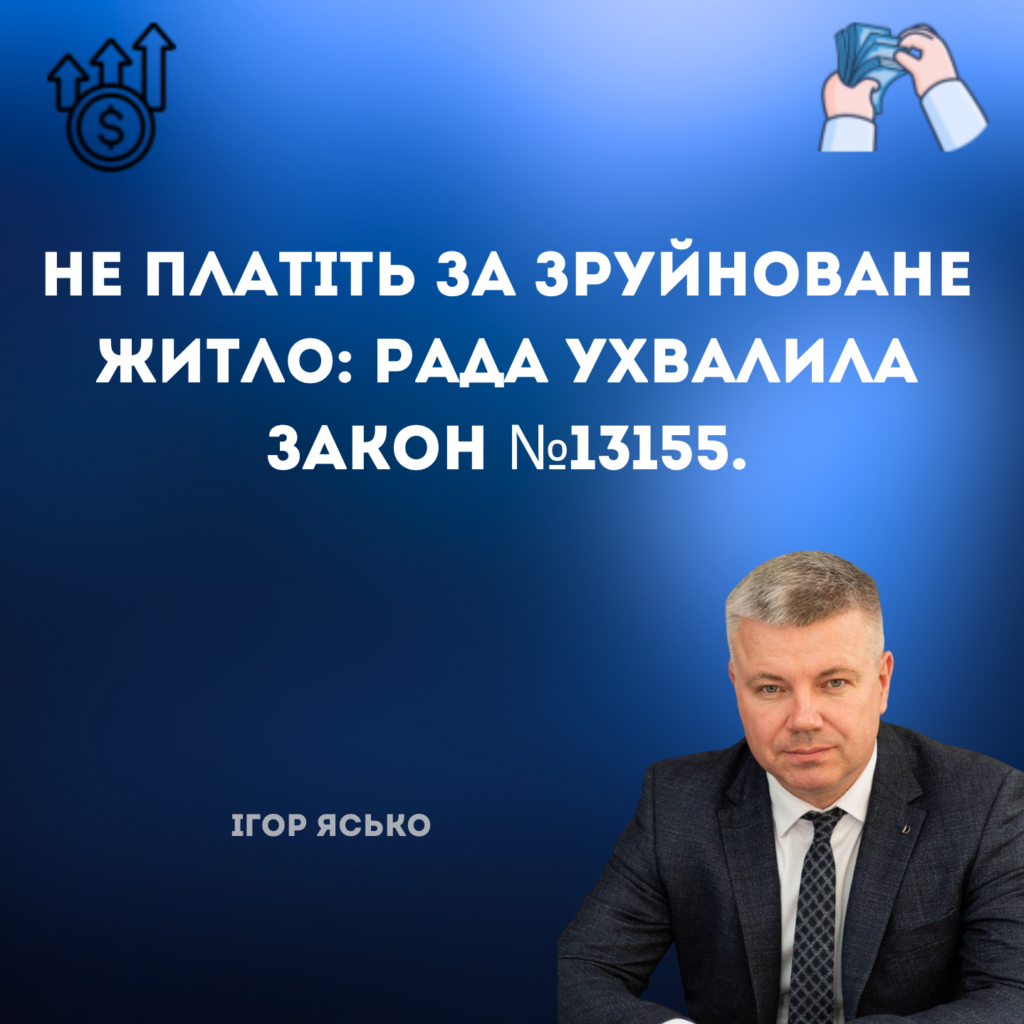
Do not pay for destroyed housing: the Rada has adopted Law No. 13155

Потрібна допомога адвоката? Залишай заявку In March 2026, the Verkhovna Rada adopted Law No. 13155, which exempts owners of damaged or destroyed housing from paying utility bills for dwellings unfit for living and changes the approach to relations between consumers, providers and local authorities. Essence of the adopted lawThe document exempts owners and users of housing from paying utilities for properties destroyed or significantly damaged as a result of russian aggression, provided that such housing is entered in the state Register of Damaged and Destroyed Property. The law prevents the accrual of “debts” for resources that are not actually consumed and establishes for utility companies a mechanism to exclude such volumes from total consumption, helping to balance local finances. Who does not have to payThe law covers several categories of residential properties:private houses, apartments and other residential premises destroyed or damaged as a result of hostilities, terrorist attacks or shelling;properties declared unfit for habitation based on a technical assessment or a decision of local authorities;assets recorded in the Register of Damaged and Destroyed Property, regardless of whether reconstruction has begun. Both owners and tenants are entitled to this exemption if they were officially registered utility consumers. To exercise this right, it is sufficient to provide utility providers with data from the Register or a commission’s act, so the system works on the basis of official information from a single state resource rather than manual applications. Problem the law solvesSince the start of the full‑scale invasion, hundreds of thousands of Ukrainians have lost their homes, yet utility billing systems continued to automatically accrue charges, creating debts for non‑existent consumption and legal and financial traps. Law No. 13155 addresses this problem systemically: it prohibits charging for utilities in destroyed or uninhabitable housing, cancels already accrued amounts from the moment the dwelling became unfit for living, and obliges service providers to write off such charges within a defined period without applications or additional costs for consumers. How it will work in practiceThe law’s mechanism relies on data from the Register of Damaged and Destroyed Property: everyone who reports damage via Diia or a CSC receives a unique record that becomes the legal basis for stopping accruals. Local authorities pass this information to utility providers, after which the consumer is automatically removed from the list of payers, while for temporarily occupied territories a simplified data‑entry procedure is envisaged after de‑occupation. To ensure transparency, the Ministry for Communities and Territories Development must establish electronic interaction between utilities and state registers to promptly record changes in a property’s status, including after reconstruction. Who compensates utilities’ lossesThe law also answers a key question: how to keep local utility providers financially stable. Compensation will come from earmarked state‑budget funds and international assistance, including the Ukraine Recovery Fund. The Ministry of Finance must create a dedicated program to reimburse companies for services that were planned but not actually provided. This is crucial, as without compensation many utilities would face insolvency. Social and political dimensionThe law’s adoption shows that the state takes responsibility for a fair balance between the interests of citizens and businesses even during war, without shifting losses onto people who have already suffered. It is also a political signal: every family and every destroyed home is not left “for later”, and the law’s provisions become part of the post‑war recovery strategy, where protection of property rights and digital transparency of procedures are priorities. Implementation challengesIn practice, technical difficulties are likely: not all communities have up‑to‑date databases, some utilities use outdated systems, and data exchange between registers is not yet fully automated, so full relief from charges may take several months. Another challenge is documenting damage where housing lacks a cadastral number or where papers were lost; although the law provides simplified procedures, they still need to be detailed in secondary legislation. Why this law is a step toward a new state policyExempting affected people from utility payments is not only a humanitarian move but also a shift to a model in which the main value is the person, not an “account number”, and which may extend to other areas, such as automatic termination of tax or lease obligations when property is destroyed. Adoption of Law No. 13155 is in line with international humanitarian practice, as in many war‑affected countries the state assumed responsibility for compensating utilities for people who lost their homes. Future outlookAfter the war, this law will become part of a digital housing registry system that automatically determines each property’s status, simplifying reconstruction and ensuring fair billing in peacetime. For people who lost their homes, it is a signal of trust and genuine social responsibility from the state, while further success will depend on sound secondary legislation, effective digital integration and honest local administration. If you have any questions or issues related to the application of Law No. 13155, registering housing in the Damaged Property Register or interacting with utility companies, you should consult a legal expert specializing in compensation for war‑related damage. Author: Ihor Yasko, Managing Partner of the law firm “WINNER”, PhD in Law. https://www.youtube.com/watch?v=N9Rdi6CWE1s

Без рубрики

Removed from the register: the court prohibited the Territorial Recruitment Center from serving draft notices

Потрібна допомога адвоката? Залишай заявку The lawfulness of actions by Territorial Recruitment Centers (TRCs) and Joint Centers towards persons removed or excluded from the military register has become one of the key issues in wartime case law. Recent rulings of administrative courts of appeal show a clear trend: if a man has proper evidence that he has been removed from military registration, any subsequent actions by a TRC – from serving a draft notice to referring him to a military medical commission (MMC) – are found unlawful. In a high‑profile case, the court expressly stated that a person removed from the military register is neither liable for military service nor a reservist and therefore does not fall under mobilisation measures, so a draft notice and referral to an MMC in respect of such a person are legally unfounded. Case background: checkpoint, draft notice and fine for refusal to undergo MMCAt a checkpoint, authorised TRC officers tried to serve a man with a draft notice and simultaneously issued a referral to an MMC, but he refused, referring to his removal from the military register and insisting that any actions towards him must be taken only at his place of registration. In response, the TRC drew up a protocol under Part 2 of Article 210‑1 of the Code of Administrative Offences and fined him UAH 25,500 for allegedly refusing to undergo the MMC; the case file included the notice, the refusal act, copies of his passport and his military ID, which became the key piece of evidence in court. Key argument: the mark on removal from military registrationThe court of appeal paid particular attention to the military ID, which contained a mark confirming the man’s removal from the military register under subparagraph “g” of paragraph 5 of Article 37 of the Law of Ukraine “On Military Duty and Military Service” (for example, due to reaching the maximum age or on other grounds). The court stated directly that such a mark means the person no longer has the status of someone liable for military service or a reservist. Accordingly, reconciliation of military‑registration data, summonses to the TRC, referrals to the MMC to determine fitness and any mobilisation‑related actions in respect of that person lack legal basis and are regarded by the court as unlawful. In effect, the court settled the dispute: possession of a valid document with a proper mark on removal from the register takes precedence over the absence or late updating of data in departmental registries (such as “Oberig” or internal TRC databases). Why registry entries do not override the military IDOne of the core practical problems is the gap between registry data and the marks in military IDs. Case law proceeds from the premise that TRC mistakes in updating the register of conscripts, persons liable for service and reservists may not worsen a citizen’s position. In a case where the TRC failed to update the “Oberig” registry to reflect a man’s exclusion from the military register, the court found such inaction unlawful and obliged the TRC to update the data, emphasising that once a person is officially excluded from the register, their status cannot depend on bureaucratic failures. Therefore, in the checkpoint case it was the military ID with the removal mark that served as the starting point for assessing the lawfulness of the TRC’s actions. Unlawfulness of referring to an MMC without the status of a person liable for serviceCourts consistently stress that undergoing an MMC as part of mobilisation measures is possible only for persons who have the status of conscript, liable for military service or reservist and who have been duly summoned to the TRC. In the discussed ruling, the court of appeal clearly stated that referring a man removed from the military register to an MMC contradicts the law and the Military Registration Procedure, so refusal to undergo the MMC in such a situation does not constitute an offence, and a fine for “failure to appear” is unlawful. Courts take a similar view where a TRC cannot prove proper service of a draft notice or referral: without a signature, date and proper record of service, the very elements of an offence are missing. Implications for TRC practice and for citizensThe appellate court’s decision has far‑reaching consequences not only for the individual claimant but also for overall practice in TRC interactions with persons excluded or removed from the military register. The court effectively confirmed that: a draft notice to appear at a TRC may not be served on someone who has been excluded/removed from the register; such a person may not be referred to an MMC within mobilisation procedures; involving them in mobilisation measures is unlawful; fines for “failure to appear” or “refusal to undergo an MMC” in such circumstances must be quashed. For citizens, this means that a documented status (a mark in the military ID, a decision on exclusion from the register, etc.) is the key piece of evidence in any dispute with a TRC. For TRCs, it means that ignoring status changes, attempting to “overlook” old marks in IDs or delaying registry updates may lead to lost court cases and findings that their actions were unlawful. Practical takeaways for men removed from the military registerCase law suggests several important practical steps for persons removed or excluded from the military register: Keep the original military ID with the removal/exclusion mark and make notarised copies. If a draft notice or MMC referral is attempted, calmly refer to the mark in the ID and demand that this be recorded in an official act. If, despite this, a protocol is drawn up and a fine imposed, challenge the decision in court, submitting the military ID as the principal piece of evidence. If the TRC has not entered information on exclusion into registries (such as “Oberig”), seek a court order declaring such inaction unlawful and obliging the TRC to update the data. It is also important to remember that a note in the “Reserv+” app about an “offence

Без рубрики

VAT for sole proprietors from 2027: how not to lose your business

Потрібна допомога адвоката? Залишай заявку The discussion on introducing VAT for sole proprietors with “large” turnovers is moving from rumours to concrete bills: the Ministry of Finance proposes raising the mandatory VAT registration threshold to UAH 4 million in annual revenue from 1 January 2027, so there is little time to prepare, but the overall logic of the reforms is already visible. What will change from 2027The key innovation is a new unified threshold for mandatory VAT registration: UAH 4,000,000 in annual revenue instead of the current UAH 1 million. This threshold is planned to be the same for both sole proprietors and legal entities, regardless of whether they are on the simplified or the general tax system. If an entrepreneur (individual or company) exceeds the UAH 4 million limit over a 12‑month period, they must become a VAT payer and work under the general VAT rules. The scenario “I am on the single tax, so VAT does not concern me” will no longer work; the simplified regime will cease to be a “shield” from VAT for high‑turnover businesses. Automatic registration and a “soft start”The “soft start” of VAT provides for automatic registration of sole proprietors as VAT payers based on their 2025–2026 tax returns, without any application from the entrepreneur, so attempts to artificially understate turnover may fail. The first quarter of 2027 is expected to be a transition period, and from the second quarter symbolic fines of UAH 1 for initial violations will gradually be replaced by full penalties under the Tax Code. Who exactly will be affected: sole proprietors and groupsDespite headlines about “VAT for all sole proprietors”, this is not about total taxation but about entrepreneurs whose turnover exceeds the set threshold. Under the current logic of the National Revenue Strategy and Ministry of Finance drafts, those most at risk are sole proprietors in the second and third groups working in trade, B2B services, IT and other high‑margin sectors. At the same time, sole proprietors with annual turnover up to UAH 4 million will retain the right to work without VAT while paying the single tax at 5% (this approach is reflected in the bill’s explanatory notes and expert reviews). For those who exceed the threshold and become VAT payers, a shift to a 3% single tax rate plus 20% VAT is envisaged, which significantly changes the business economics. Why the state and the IMF insist on VAT for sole proprietorsThe state is pushing VAT for sole proprietors at the IMF’s insistence and to level the playing field: large sole‑proprietor businesses on the simplified regime can currently operate without mandatory VAT, while companies with the same turnover must pay it. The government expects additional tens of billions of hryvnias in annual revenue and wants to shut down schemes that “split” businesses into many sole proprietors and use the simplified regime in large B2B chains. Pros and cons of the new thresholds for small businessFor microbusinesses, the new UAH 4 million threshold is more a relief than a threat. Today the formal VAT threshold is UAH 1 million, so after the reform a large share of microbusinesses will fall outside mandatory VAT registration altogether. This matches the Ministry of Finance’s rhetoric of protecting the smallest players and focusing on sole proprietors whose turnover is closer to that of medium‑sized businesses. For mid‑sized sole proprietors the situation is more complex: on the one hand, VAT means extra bookkeeping, reporting, cash‑flow gaps and the need for professional accounting support; on the other hand, VAT payer status can become a competitive advantage when dealing with large clients who themselves are VAT payers and are interested in input tax credits. Automation and control: why “schemes” will work worseThe VAT reform for sole proprietors comes as part of a broader digitalisation package: fiscal cash registers, bank monitoring and the tax authority’s e‑services will allow the tax office to see turnovers almost in real time and detect when the UAH 4 million threshold is exceeded. Against this background, schemes such as splitting a business into several sole proprietors, mixing personal and business funds or understating revenue become much riskier, as data from cash registers, banks and tax returns will be consolidated and may lead to VAT assessments and broader audits. What will change for tax rates and regimesIntroducing VAT for part of the sole‑proprietor segment fits into the overall reform of the simplified tax system for 2025–2027. Planned changes include merging the second and third groups into a single regime, differentiated tax rates depending on turnover and activity type, and automating sole‑proprietor registration through banks. In this context, the 5% single tax without VAT is expected to remain for those who stay below UAH 4 million, while VAT payers will work under a 3% single tax rate plus 20% VAT. For sole proprietors working with VAT‑payer clients, this is partly offset by the ability to claim input VAT, but for mostly B2C businesses, adjusting prices and margins will be critical. Strategy for sole proprietors: prepare for VAT or “fit into the limit”Entrepreneurs with turnover around UAH 4 million face a choice: artificially restrain growth to avoid VAT, or accept the new rules and build a more mature financial model that factors in VAT. For sole proprietors with projected turnover of UAH 4–8/10 million, it is often more advantageous to prepare in advance to become VAT payers: review prices and costs, consider incorporation as a company and, where possible, pass part of the VAT burden on to counterparties or offset it through efficiency gains. What sole proprietors should do nowAlthough the formal start of the changes is set for 2027, the preparation phase has effectively already begun. A practical checklist includes: analysing turnover for 2024–2025 and forecasts for 2026–2027 to see whether you will cross the UAH 4 million line; cleaning up your bookkeeping, separating personal and business transactions and using transparent payment tools (merchant acquiring, a dedicated business account, fiscal cash registers); modelling “with VAT” and “without VAT” scenarios to understand how

Без рубрики

Mandatory VAT registration for sole proprietors: new thresholds and action strategy

Потрібна допомога адвоката? Залишай заявку The issue of mandatory VAT registration for sole proprietors on the single tax has already moved beyond “sometime later” and into concrete bills, figures and timelines; in parallel, an increase in the registration threshold and its link to the minimum wage are being discussed. In essence, by complying with IMF requirements, the state wants large turnovers in the small‑business segment to be taxed with VAT under the general rules, and the key questions now are who must register and when, and what sole proprietors should already be doing. What is the current threshold for mandatory VAT registrationAt present, mandatory VAT registration arises when the volume of taxable transactions over the last 12 months in total exceeds UAH 1 million, both for the general tax regime and for single‑tax sole proprietors, with turnover on the simplified regime also counted. If a sole proprietor entitled to carry out VAT‑able operations exceeds this million, they must file form No. 1‑VAT within the prescribed time and register, and ignoring the 12‑month “rolling” period is what most often leads to back‑assessed VAT and penalties. What is planned to change: the “magic” UAH 1 million and a new thresholdDebate now focuses on changing the threshold for mandatory VAT registration and introducing special rules for single‑tax sole proprietors. Initially, a fixed limit of UAH 1 million in annual income was proposed for almost all sole proprietors except the very smallest. In parallel, a link to 400 minimum monthly wages was suggested (around UAH 3.46 million in turnover in 2026), and public statements also mention raising the threshold to UAH 2–4 million to soften the impact on microbusiness. Analytical pieces increasingly cite UAH 4 million as a baseline threshold from 2027, but for now these are only draft concepts that may change during the parliamentary process. Single‑tax sole proprietors: who the new regime will affectToday mandatory VAT registration for single‑tax sole proprietors is triggered by the general UAH 1 million threshold, but the reform specifically targets simplified‑regime businesses with higher turnovers. Under the scenarios being discussed, mandatory VAT would extend to sole proprietors in all groups, except possibly the smallest and certain special categories (for example, e‑residents). Several vectors of change matter for simplified‑regime taxpayers: higher turnover caps for the single‑tax groups; a unified VAT‑registration threshold that may exceed the current UAH 1 million; and a possible merger of the second and third groups with differentiated tax rates. In practice, this means that sole proprietors will be allowed to “grow” to significantly higher turnovers while staying on the simplified system, but once they reach the specified limit they will effectively be required to enter the VAT system, with all the additional bookkeeping, reporting and liability that entails. Why the state insists on VAT for sole proprietorsThe government and the IMF offer pragmatic reasons. VAT is one of the state’s main revenue sources, and the current situation, where substantial turnovers can circulate within the single‑tax segment without VAT, looks too lenient to fiscal authorities. It also creates structures where companies and large taxpayers work with simplified‑regime sole proprietors without VAT, thereby reducing their tax burden. Introducing mandatory VAT registration for “large” sole proprietors is intended to increase revenue without raising rates, level competition between sole proprietors and companies, and limit opportunities to split businesses into dozens of “mini‑sole‑proprietor” entities. Recognising that business views this as an extra burden, policymakers are seeking a compromise in the form of a multi‑million‑hryvnia threshold that exempts true micro‑entrepreneurs and focuses the reform on larger players. Practical implications for sole proprietors: what to watch nowEven though broad mandatory VAT rules for single‑tax payers are linked to 2027, preparation should start now. Sole proprietors on the simplified system should regularly monitor turnover using a rolling 12‑month window rather than just calendar years; model how prices, margins and relationships with counterparties would change under VAT; and segregate transactions that might be VAT‑able to ease the transition. A separate issue is switching from the single tax to the general regime: experts stress that if a sole proprietor who has exceeded UAH 1 million switches to the general regime, this does not relieve them of the duty to register for VAT; months on the simplified regime still count, and ignoring this rule can lead to backdated assessments and penalties. Strategy: run from VAT or work transparentlyBusinesses often respond to tighter regulation by trying to “fit under the limit”, for example by capping turnover, splitting into several sole proprietors or moving part of operations into the shadows. However, given ongoing digitalisation (fiscal cash registers, the e‑cabinet, bank monitoring) and the growing preference of corporate clients for VAT‑registered suppliers, a strategy of “escaping VAT” is unlikely to succeed. For sole proprietors with multi‑million turnovers, it is more rational to design a transparent business model that incorporates the VAT chain, optimise costs and, where appropriate, consider converting into a company. What to do now: a brief checklistWhile bills are still under discussion and final figures and dates may change, single‑tax sole proprietors should focus on what they can control: Analyse turnover for the last 12 months against the current UAH 1 million threshold and make sure the obligation to register for VAT has not already arisen. Model financial results under possible UAH 2–4 million thresholds and assess whether you will fall into the mandatory VAT zone after the reform. Review your client and supplier base to see whether VAT‑payer status could be a competitive advantage in your market. Set up basic accounting (even in a simple CRM or spreadsheet) that will allow you to adapt quickly to VAT reporting if needed. In summary, mandatory VAT registration for single‑tax sole proprietors is not so much “the end of the simplified regime” as another stage in its maturation. Those who prepare in advance can not only minimise risks but also use the new rules as an opportunity to rethink their business model and move towards greater transparency and cooperation with larger clients. If you face questions about

Без рубрики

Procedure for verifying the ultimate beneficial owner

Потрібна допомога адвоката? Залишай заявку The topic of ultimate beneficial owners (UBOs) has long since moved beyond a purely “technical” registration requirement and has become a key element of financial monitoring, compliance and business transparency, closely watched by the Ministry of Justice, banks and the tax authorities. Law No. 361‑IX requires companies not only to disclose UBO data but also to keep it up to date and confirm the ownership structure, while the Ministry of Justice uses special regulations to set out a detailed algorithm for state registrars to verify this information. Regulatory framework: what governs UBO checksThe core act is Law of Ukraine No. 361‑IX “On preventing and counteracting money‑laundering”, which defines a UBO as a natural person who exercises decisive control over a legal entity regardless of their formal ownership stake. The procedure for checking UBO and ownership‑structure information submitted by a legal entity is detailed in MoJ Order No. 3265/5, substantially updated in 2025 by Order No. 1173/5, which clarified the registrar’s workflow, timelines, required data and grounds for removing a “data unreliable” mark from the companies register. When the verification procedure startsVerification of UBO data is triggered either by the company itself (when it files documents to confirm or update information) or by red flags about potential inaccuracies from the Ministry of Justice, banks, supervisory bodies, other registers or inconsistencies found in the companies register. If doubts arise, the registrar may send a formal request for explanations and supporting documents; the company usually has up to 10 business days to respond, and unjustified failure to do so risks a “data unreliable” mark in the register and financial penalties. Which UBO data is checkedThe updated procedure specifies what must be identified for the UBO and for persons through whom indirect control is exercised. For an individual UBO, the registrar checks, in particular: full name, citizenship (all, if multiple), place of residence, date of birth, passport details and tax identification number (where available), plus the nature and degree of participation or control in the company. For legal entities in the ownership chain, the registrar reviews the name, registered address, identification code (for residents) and size of the equity or voting stake, paying special attention to foreign companies, trusts and other vehicles that could conceal the true controlling person. Registrar’s workflowOrder No. 3265/5 sets out a step‑by‑step review of the company’s explanations and documents. The registrar first performs a formal check of completeness, format and timing (including how recent notarised UBO documents are), then conducts a substantive review of the ownership structure and identification data, assessing the transparency of the control chain and the presence of an individual as UBO and, if needed, requesting extra documents or foreign registry extracts. Based on the results, the registrar issues a notice either confirming the UBO data or identifying discrepancies and requesting remediation; once the information is deemed reliable, a corresponding entry is made in the register and any “data unreliable” mark is removed. When checks are not carried out or are discontinuedThe revised rules expressly list cases where UBO checks are not performed or can be discontinued, for example where the company falls into a category exempt from UBO disclosure (state bodies, certain public companies, etc.) or where the register already contains confirmed, up‑to‑date data without any red flags. Verification also stops if the company is liquidated or if the required documents cannot be obtained for objective reasons, and the registrar informs the Ministry of Justice accordingly; however, such situations do not relieve officers of liability for failure to submit or update UBO data on time where this was in fact possible. UBO checks in financial‑monitoring and banking practiceAlongside the registration process, there is a “parallel front” of UBO verification by primary financial‑monitoring entities, especially banks. They must identify their clients’ UBOs, obtain the ownership structure, take steps to verify the UBO’s identity and keep this information current for as long as the business relationship lasts. In practice this means that even if the registry data is formally “in order”, a bank may refuse to open an account or may block transactions if it doubts the reality of the declared UBOs, so the quality of the ownership‑structure mapping and the consistency of information across registers, internal documents and actual business processes is just as important as formally meeting Ministry of Justice requirements. Risks and liability for inaccurate UBO dataBreaches of UBO obligations now carry significant financial penalties for failure to submit, late updating or knowingly false information, and a “data unreliable” label in the register immediately alerts banks, counterparties and regulators and can effectively paralyse a company’s operations. Additional risks arise from the use of nominee owners, offshore chains and complex trust structures that hide real control; in such cases the Ministry of Justice and financial‑monitoring bodies pay close attention to identifying the true beneficial owners, and violations can lead not only to fines but also to suspicions of money‑laundering or terrorist‑financing. How businesses should prepare for UBO checksModern UBO requirements are essentially a question of a company’s overall legal and compliance maturity. Companies should move beyond one‑off ownership charts and create an internal process around UBO information: maintain up‑to‑date internal diagrams of ownership and control, align data across charter documents, the register, bank questionnaires and contracts, prepare document packages in advance for potential MoJ or bank requests, and appoint a responsible person for liaising with registrars and financial‑monitoring entities. With this setup, even a more detailed UBO verification regime becomes part of a normal compliance cycle rather than a stress factor. If you have questions about identifying UBOs, confirming ownership structures or dealing with registrars or banks on UBO issues, it makes sense to seek professional advice to assess your risks and design an appropriate disclosure model. Author: Ihor Yasko, Managing Partner at Winner Law Firm, PhD in Law. https://www.youtube.com/watch?v=RhPajsWizRE

Без рубрики

Expired Drager 6820: when breath test results no longer count

Потрібна допомога адвоката? Залишай заявку A driver’s breath test using an alco‑tester is one of the key pieces of evidence in cases under Article 130 of the Ukrainian Code of Administrative Offences, but its probative value directly depends on compliance with the technical requirements for the device. Court practice shows that if a Drager “Alcotest 6820” has been calibrated in breach of the six‑month interval set in the user manual, the results of such a test are treated as inadmissible evidence and the examination itself is considered invalid within the meaning of Article 266 of the Code. Legal requirements for the test and the deviceArticle 266 of the Code lays down strict rules for breath tests for alcohol, drugs or other intoxication, including the use of certified technical devices that are in proper working order and have passed all required checks. The Drager “Alcotest 6820” manual expressly provides that calibration must be carried out every six months; this is not a recommendation but a condition for correct measurements under the Law on Metrology and Metrological Activity. Thus, the calibration interval forms part of the legally prescribed procedure for the test. If the police ignore these requirements, both the manufacturer’s instructions and metrological standards are breached, which directly undermines the reliability of the readings. Essence of the court ruling: expired calibration = invalid testIn the case at hand the court found that the driver’s alcohol test was carried out with a Drager “Alcotest 6820” whose last calibration had been performed more than six months before the test. The print‑out and metrological documents clearly showed the date of the last calibration, which fell outside the allowed interval; the police provided no other proof of proper technical maintenance. Relying on part 5 of Article 266, the court held that any test conducted in breach of this provision is invalid. Since it is the police who must ensure the use of a properly maintained and timely calibrated device, the consequences of non‑compliance cannot be shifted onto the driver. As a result, the proceedings under Article 130 were closed for lack of proper and admissible evidence of intoxication. Court’s reasoning: measuring equipment as a source of evidenceThe court emphasised that a gas analyser is measuring equipment and therefore falls under metrology law. The reliability of the test result depends on adherence to the servicing schedule, including periodic calibration. If more than six months pass between calibrations, the risk of systematic error increases and cannot be assessed without special procedures, so the readings cannot be treated as conclusive proof. Other judgments have focused not only on calibration intervals but also on certification and state registration of alco‑testers. Using devices that are not listed in the relevant registers or have expired certificates has likewise been considered a breach of Article 266 and has led to cancellation of sanctions. This shows that procedural formalism in “alco‑tester cases” is a safeguard for drivers’ rights rather than excessive bureaucracy. Implications for drivers and the policeFor drivers, the ruling is an important defence guideline. First, every driver may demand that police officers produce documents for the device: serial number, conformity certificate, and calibration or verification record with the date. If the six‑month gap between checks is exceeded, the driver can record this in the test report or protocol and later invoke invalidity of the test under part 5 of Article 266. Second, in court it is advisable to request the full technical file for the specific Drager “Alcotest 6820”: inspection log, verification acts, operating manual. If these documents are missing or show breaches of service intervals, courts usually treat the test results as improper evidence and close the case. For the police, this case law means stricter organisational requirements: proper inventory of devices, timely calibration, training of officers on metrological rules and clear communication to drivers about measurement error. Ignoring these aspects leads not only to lost cases but also to potential disciplinary liability. Risks of using “expired” alco‑testersUsing devices with an expired calibration interval creates a systemic risk: dozens or hundreds of protocols may be based on unreliable data. Once such violations are discovered, the defence can seek review of final decisions on the basis of newly discovered circumstances. Moreover, practice with the Drager “Alcotest 6820” aligns with cases where courts have questioned the legality of particular models altogether — for example, where they were not duly registered or had no conformity assessment. This shows that courts are ready to scrutinise the technical basis of the accusation rather than rely mechanically on a police report. If you have questions or problems related to challenging breath‑test results, checking the legality of using a Drager “Alcotest 6820”, collecting evidence in a DUI case under Article 130 or choosing a defence strategy in court, you should seek qualified legal assistance — timely advice will help you identify procedural errors, challenge defective evidence and effectively protect your rights. Author: Yevhenii Murchenko, Head of the Criminal Law and Procedure Practice of the law firm “WINNER”. https://www.youtube.com/watch?v=RhPajsWizRE

Без рубрики

The client does not pay for a card breach if the bank has not proved his fault

Потрібна допомога адвоката? Залишай заявку This position of the Civil Cassation Court of the Supreme Court, set out in its ruling of 15 September 2025, has become a cornerstone for disputes between banks and clients over unlawful debiting of funds. The Court stressed that a client is released from liability if he promptly informs the bank about the transactions and the financial institution fails to provide indisputable evidence of his fault or involvement in the breach. Legal grounds for protecting the client Under paragraph 9 of Section VI of Regulation No. 705 on cash operations in the national currency (in force at the time of the case), a user is not liable for payment transactions if the electronic payment instrument has been blocked or if the bank has not proved the user’s gross negligence. The Supreme Court extended this principle, holding that the mere fact of entering a PIN code or other credentials does not prove the client’s fault; the bank must establish a causal link between the client’s actions and the card breach. In the case No. [number not available in open sources], the Civil Cassation Court clearly formulated the rule that the burden of proof lies with the bank, and only indisputable evidence (logins, IP addresses, geolocation, behavioural patterns of the client) can shift liability onto the victim of fraud. The very fact that 69,342 UAH were debited in May 2022 did not justify charging the client, because the bank failed to prove his involvement in the fraud. Analysis of the Supreme Court’s position: burden of proof on the bank The Court emphasized that banks often try to shift responsibility to clients by referring to “correct data entry”. The judges found this insufficient: correct execution of a transaction shows only that someone had technical access to the card, not that the owner consented or acted negligently. The appellate court in this case wrongly accepted new evidence from the bank that had not been presented at first instance, which the Supreme Court viewed as a breach of the principles of good faith and full disclosure of evidence (discovery) under the Civil Procedure Code. This approach is consistent with EU Directive PSD2, which places primary responsibility for system security and the burden of proving customer fault on payment institutions. In Ukraine, this means that the bank as the card issuer must protect payment information and compensate losses unless and until it proves the opposite. Practical implications for clients and banks For clients, the Supreme Court’s position is a powerful shield. If you discover unauthorised debits: immediately block the card via the app or the bank’s hotline; notify the bank in writing (email or registered mail), demanding an investigation and a refund; file a police report for fraud to document your good faith; if the bank refuses, bring a claim in court and rely on the Supreme Court ruling. Banks, in turn, must enhance security by implementing two‑factor authentication, monitoring suspicious transactions, and promptly blocking and investigating them. Practice shows that banks often lose such cases due to the lack of proof of customer fault, which pushes the industry towards better data protection. In 2024–2025, such disputes increased amid a surge of phishing and scam schemes, with clients losing from a few thousand to hundreds of thousands of hryvnias. The Supreme Court drew a clear line: a bank cannot automatically debit funds from a “suspicious” account without proper proof. Case‑law: key Supreme Court decisions In its ruling of 15 September 2025, the Civil Cassation Court allowed the client’s claim and rejected the bank’s demand to recover 69,000 UAH debited by fraudsters. The first‑instance court had sided with the client, the appeal reversed that decision, but the cassation restored it, emphasizing the burden of proof on the bank. Similar conclusions were reached in rulings No. 235/2054/21 and No. 161/6855/19: a client is not liable if the card was blocked or the bank failed to prove gross negligence. This practice applies to all banks, where typical fraud schemes involve phishing, malware and social engineering. The Supreme Court also barred banks from submitting new evidence on appeal if they had not presented it in the first instance, preventing procedural manipulation and protecting clients. Risk‑mitigation recommendations To minimise your risk: enable push notifications and two‑factor authentication on all cards; never enter card details on suspicious websites or share them over the phone; regularly check statements and set transaction limits; if a breach occurs, block the card immediately and record all communications with the bank. Banks should invest in AI‑based monitoring, educate customers and prepare a strong evidentiary base for disputes; otherwise they risk losing in court. The Supreme Court’s stance shifts the balance in favour of clients, making banks accountable for payment system security. Further harmonisation of case‑law and potential NBU regulatory changes aimed at stronger consumer protection are expected. If you have questions or problems related to challenging unauthorised transactions, recovering funds from a bank, or protecting your rights as a financial services consumer, you should seek qualified legal assistance — timely advice will help you assess the evidence, identify procedural errors and effectively defend your rights. Author: Ihor Yasko, Managing Partner at Winner Law Firm, PhD in Law. https://www.youtube.com/watch?v=4nzvofPywF0&t=9s

Без рубрики

Income tax return‑2026: who has to file?

Потрібна допомога адвоката? Залишай заявку The 2026 tax return campaign gives individuals not only the obligation to report their income for 2025 but also the opportunity to claim a tax rebate. To avoid penalties for non‑filing or errors, it is crucial to understand exactly who must declare their income and at what tax rates it will be taxed in 2026. Who is required to file a return The basic rule is that an annual personal income and assets tax return must be filed by individuals who in 2025 received income from which tax was not paid “automatically” by a tax agent (employer, bank, etc.). Such persons include: citizens who received income from other individuals or non‑residents (rent, sale of property, foreign fees, freelance services, and similar); individuals‑entrepreneurs on the general taxation system and persons engaged in independent professional activities (lawyers, private bailiffs, notaries, doctors, etc.); persons who received foreign income (salary, dividends, royalties, investment income, rental of property abroad); resident individuals who sold movable or immovable property, corporate rights or securities outside the tax‑agent system; persons who in 2025 received inheritances or gifts from non‑residents or from individuals who are not first‑degree relatives; foreigners who, based on the 2025 results, became tax residents of Ukraine – they must declare both Ukrainian‑source and foreign‑source income; residents who are leaving Ukraine for permanent residence abroad – no later than 60 calendar days before departure. A separate group consists of those who are not obliged but may file a return voluntarily to obtain a tax rebate (for example, for tuition fees, mortgage interest, life insurance premiums, charitable donations). Filing deadlines in 2026 The income declaration campaign started on 1 January 2026. The main deadlines are: for mandatory declaration of income for 2025 – until 1 May 2026 inclusive; for those filing solely to claim a tax rebate – until 31 December 2026 inclusive; for persons leaving Ukraine for permanent residence abroad – no later than 60 calendar days before departure. Entrepreneurs on the general system report for the year within the time limits set for business returns (typically by 9 February, although in 2026 specific rules may be set by separate guidance of the Tax Service). Key PIT rates in 2026 Personal income tax in 2026 is applied at several rates depending on the type of income: 18% – the basic PIT rate for most income (wages, civil‑law service contracts, sick leave, foreign income, most entrepreneurial income, investment gains); 5% – for certain passive income (some dividends from resident corporate income‑tax payers, particular investment gains, income from the sale of specific assets, subject to Tax Code conditions); 0% – preferential operations expressly listed in the Tax Code (certain types of state aid, humanitarian assistance, compensation for damage, etc.); 9% – specific cases (for example, dividends from non‑residents or from single‑tax payers, where no other rule applies). For entrepreneurs on the general system, PIT is charged at 18% of net taxable income (income minus documented expenses). Military levy in 2026 In addition to PIT, a military levy is charged and remains a key element of the tax burden during martial law: for most individuals (wages, civil‑law contracts, rent, foreign income, etc.) the levy rate is 5% of the taxable base; for single‑tax entrepreneurs of groups 1, 2 and 4 a fixed levy applies – 10% of the monthly minimum wage (864.70 UAH in 2026); for single‑tax entrepreneurs of group 3 – 1% of income. In the annual income and assets tax return, individuals usually report both PIT and the military levy payable to the budget. Who may choose not to file Individuals are not required to file a return if during 2025 they received only: income from tax agents (wages, bonuses, sick pay, official dividends from resident companies, etc.) on which tax has already been withheld; social benefits, pensions, scholarships, unemployment benefits, where these payments are not subject to additional taxation; proceeds from the sale of property taxed through a notary acting as a tax agent, and did not receive other income that requires declaration. Even in such cases, individuals may voluntarily file a return to exercise their right to a tax rebate. Practical tips: how to avoid mistakes Use the taxpayer’s Electronic Cabinet, where some data are imported automatically, and gather all supporting documents before filling in the form (income certificates, contracts, bank statements, documents for the tax rebate). Pay particular attention to foreign income: apply the correct NBU exchange rate and check whether foreign taxes can be credited. Remember that late filing or late payment entails fines and interest, so do not postpone your return until the last days, especially if your income structure is complex. If you have questions or difficulties regarding whether you must file, how to complete the income and assets tax return, how to report foreign income or apply PIT and military levy rates, you should seek professional tax advice — timely assistance will help you avoid penalties, optimise your tax burden and lawfully benefit from all available reliefs. Author – Yuliia Popadyn, attorney in tax and housing law at the law firm “Legal Company ‘WINNER’. https://www.youtube.com/watch?v=4nzvofPywF0&t=9s

Scroll to Top