Author name: admin

Без рубрики

Will housing privatization be terminated in Ukraine?

Since 1992, the Law on the Privatization of State Housing has enabled millions of Ukrainians to acquire their own homes. However, in 2025 this thirty‑year program is coming to an end: the Verkhovna Rada is considering draft law No. 12377, which terminates free privatization and repeals the outdated 1983 Housing Code, replacing them with new affordable‑housing mechanisms. New draft law: key provisions and timingThe draft law on the basic principles of housing policy was adopted by the Verkhovna Rada in the first reading on 16 July 2025. Under its provisions, one year after it enters into force – but not earlier than one year after martial law in Ukraine is lifted or cancelled – the Law of Ukraine on the Privatization of the State Housing Fund will cease to apply, meaning that the end of privatization depends on both the start date of the new law and the duration of martial law. According to official sources, work on the amendments is virtually complete, with more than 95% of proposals processed, and the effective date set for 31 December 2025, in line with European Commission requirements under the Ukraine Facility program. Why privatization is being stopped: from Soviet legacy to European integrationEnding privatization is not a random step but a response to the obsolescence of the 1983 Housing Code, which still relies on Soviet‑era approaches and no longer meets market‑economy conditions or European housing standards. The new law is one of the conditions of the Ukraine Facility program under which the EU provides funding to Ukraine, so repealing the old code and phasing out ineffective privatization is viewed as a necessary step to modernize the housing sector. The system that has operated since 1992 has not solved the housing problem: hundreds of thousands of people are queued for better housing, while the state supplies only a few hundred apartments per year, and the situation has been aggravated by mass internal displacement and more than 4.5 million IDPs. How the phase‑out will work and what it means in practiceEnding privatization means that it will no longer be possible to obtain state or municipal housing in ownership free of charge, but the program will be wound down gradually. Citizens who have already applied for privatization or are in the process will have at least one more year after the law takes effect, with the countdown starting no earlier than a year after martial law ends. Unprivatized apartments will remain in state or municipal ownership and will form part of the housing stock of local communities, which the state can use for social programs, including a system of social rent. Alternative mechanisms: toward social renting and affordable housingThe end of privatization does not deprive Ukrainians of the chance to own a home: instead of the old model, a system of social housing, rent‑to‑own schemes and other modern support tools will be introduced. Its core will be social housing with an option to buy after roughly ten years of renting, when part of the rent is credited toward the purchase price. At the same time, housing cooperatives will be revived, public‑private partnerships will develop, and operators of affordable housing will emerge. Vulnerable groups – service members, IDPs, people with disabilities and large families – will receive special benefits, housing vouchers and co‑financing programs to help them access housing more quickly. European context and Ukraine Facility requirementsThe phase‑out of housing privatization is closely linked to Ukraine’s EU integration. The Ukraine Facility provides for €50 billion in support until 2027, and adopting the law on the basic principles of housing policy is a mandatory condition for receiving these funds. The European Commission insists that Ukraine replace its Soviet‑based housing system with modern, market‑ and socially‑oriented mechanisms, and ending ineffective privatization is regarded as a key step in this direction. Practical advice for those who have not yet privatizedGiven the imminent end of the program, authorities and experts urge those who have not yet formalized ownership to do so as soon as possible, because once the new law takes effect the opportunity will be lost. The procedure remains relatively simple: submit an application, copies of passports, the housing order (original or duplicate), a technical passport and other documents in person to the ASC, by mail, through a representative, or online via Diia. Free privatization is granted only once in a lifetime, and even a minimal share in an apartment counts as using this right; emergency, service or dormitory housing, and property under arrest or in the Chernobyl exclusion zone cannot be privatized. Conclusions: the end of one era and the start of anotherEnding housing privatization in Ukraine closes a thirty‑year chapter during which millions of citizens became homeowners, but new conditions require modern solutions. The program will be phased out within statutory timeframes, and its place will be taken by other tools – social rent with an option to buy, cooperatives and public‑private schemes – intended to modernize housing policy and ensure safe, affordable housing for all Ukrainians. Author – Yuliia Popadyn, attorney in tax and housing law at the Attorneys Association “Winner Law Firm”. If you have any questions about housing privatization, document processing, property rights or other related issues, please contact our team of professionals in housing policy and civil law. https://youtu.be/NvlrK2vwdMU?si=9Ai4qTohCVl099EJ

Без рубрики

When Interest Is Not Accrued for Erroneous Tax Payment – STS Comments

Since 16 March 2024, important amendments have been introduced into the Tax Code of Ukraine that significantly allow taxpayers to avoid the accrual of interest (peni) in certain situations of erroneous tax payment. Essence of the problem and new legal rulesPreviously, when a taxpayer mistakenly paid tax to a wrong budget account, such payment was treated as non‑payment of tax. This led to the formation of tax debt and automatic accrual of interest for each day of delay, even if the taxpayer had initiated the payment on time. As a result, the taxpayer found themselves in a difficult situation: although they had fulfilled their obligation according to the schedule, they were punished with fines and interest solely due to a technical error in the payment details.Now the legislation provides for exemption from such unfair liability. In essence, this can be viewed as a mechanism to protect bona fide taxpayers from sanctions in cases of mistaken transfers. Key conditions for exemption from interest in case of erroneous paymentThree conditions must be met to qualify for interest exemption (Art. 129, para. 129.9.8, Tax Code): Payment was initiated within the statutory deadline. The relevant moment is when the payment order is submitted, not when funds are credited to the account. The error relates solely to transfer to another budget account (error in recipient account details). If tax was credited to a non-budget account, the exemption does not apply. The taxpayer filed an application with the STS for refund of erroneously paid amounts under Art. 43 of the Tax Code. If these conditions are met, interest is not charged; if already accrued, it is cancelled. Procedure for refunding erroneous payments and directions of transferWhen submitting an application for refund of erroneously paid funds, the taxpayer must choose the correct direction of transfer. This is critical for the exemption from interest. According to the clarifications of the STS, when the exemption relates to an erroneous payment to another account, the taxpayer must choose the direction “To a budget account to repay the monetary obligation and/or tax debt for other payments administered by the STS”.In other words, the funds are moved from the wrongly used budget account to the correct budget account. This is not a refund to the taxpayer’s bank account or in cash, but a transfer within the budget system.The taxpayer is not obliged to request a refund to their current account if a tax debt has already arisen. On the contrary, if such a debt exists due to the error, the funds should be applied to repay that debt. Deadlines for application and required documentsThe taxpayer must submit the application within 1,095 days from the date of the erroneous payment. This three‑year period is sufficient to detect the error and file the application.The form of the application is not strictly regulated: it may be submitted in free form or electronically via the Taxpayer’s e‑Cabinet (forms J1302002 for legal entities and F1302002 for individuals).The application must specify: the type of tax erroneously paid, the amount, the date of payment, details from the payment document, the budget revenue classification code, the erroneous budget account, and the EDRPOU code of the Treasury office that maintains this account. The STS recommends attaching a copy of the payment document and a written explanation of the circumstances of the error, which helps the tax authority process the application more quickly. Exemption from fines in case of erroneous paymentInterest (peni) and fines are different legal instruments. Fines for late payment are governed by Article 124 of the Tax Code. Delays up to 30 calendar days trigger a 5% fine, and delays over 30 days a 10% fine. Since 16 March 2024, however, exemption from fines applies in parallel with exemption from interest, provided the three conditions mentioned above are met. This follows from subparagraph 112.8.8¹ of Article 112 of the Tax Code and applies specifically to erroneous payments to another budget account without missing the statutory payment deadline. Example of how the rule worksSuppose an entrepreneur must pay 10,000 hryvnia by 20 October 2024. Due to a mistake, the payment order contains an incorrect EDRPOU code and the funds go to a different budget account, although the payment was initiated on time. The tax authority detects non‑payment and accrues interest. If the taxpayer then files an application for refund with the direction to repay the tax debt, the accrued interest is not applied or is cancelled. Special aspects for single social contribution (SSC) and other paymentsFor the single social contribution (SSC) and certain non‑tax payments, the mechanism has some particularities. In case of erroneous payment of SSC to a wrong 3556 account, sanctions may be avoided by filing an application to transfer SSC to the correct account with supporting documents. However, the rule on non‑accrual of interest for erroneous transfers does not govern SSC refunds to the taxpayer; such amounts are usually offset against future SSC liabilities or refunded in cash. Conclusions and recommendationsTaxpayers should carefully check budget account details before making payments, act promptly if an error occurs, select the correct direction of fund transfer in their applications, attach supporting documents, and make active use of the Taxpayer’s e‑Cabinet for remote interaction with the STS. Author – Yulia Popadin, lawyer, tax and customs law practitioner at the Attorney Association “Legal Company WINNER“. If you have questions about erroneous tax payments, accrual of interest, exemption from fines, appealing decisions of tax authorities, or other taxation matters – contact our team of professionals in the field of tax and customs law. https://youtu.be/rEd6me-Ume4?si=4X-fM8pL8d7EsoIY

Без рубрики

Pensioners-FOPs and ESC: Should They Pay All Taxes

Since January 1, 2025, the payment of a unified social contribution has become mandatory for most individual entrepreneurs after a prolonged period of voluntary contributions. The minimum amount is 1,760 hryvnia per month. However, the legislation provides important exceptions for pensioners. Let us examine in detail what taxes and contributions pensioners-FOPs must pay. Exemption from ESC: Main Benefit Ukrainian legislation defines three categories of entrepreneurs exempted from ESC for themselves: retirees by age (regardless of pension type), retirees by length of service (military personnel, educators, law enforcement, and others), persons with disabilities of all groups receiving pension or social assistance. Key requirement: pension is paid according to Ukrainian legislation. If pension is from another state, exemption does not apply. Automatic Application and Exceptions In most cases, there is no need to inform the tax authority. The Pension Fund and tax service exchange information automatically. Exceptions apply to FOPs with disabilities receiving social assistance. They independently confirm their status with a copy of the MSEC certificate (issued before January 1, 2025) or an extract from an expert team decision. Check your status in the Electronic Cabinet of Taxpayers. When Exemption Takes Effect If a FOP acquired pensioner status in the middle of the year, ESC is paid in full (1,760 hryvnia) for that month. Exemption takes effect from the following month. For example, if retired on July 15, ESC is paid for July in full, and exemption begins in August. Unified Tax and Military Levy Exemption from ESC does not mean exemption from other payments. Legislation does not provide benefits on the unified tax for pensioners. They pay it in full depending on their group. Rates of unified tax in 2025: first group – 302.80 hryvnia/month; second group – 1,600 hryvnia/month; third group – 3–5% of income. Military levy: first and second groups – 800 hryvnia/month; third group – 1% of income. An entrepreneur-pensioner in the second group pays monthly: tax 1,600 hryvnia + levy 800 hryvnia = 2,400 hryvnia. But is exempt from ESC (1,760 hryvnia). Annual savings: over 21,000 hryvnia. Voluntary ESC Payment and Pension Recalculation Legislation allows voluntary payment. It does not change the amount of assigned pension but is taken into account when recalculating pensions for working pensioners. Recalculation is performed if at least 24 months of service record is accumulated, automatically once per year from April 1. The decision depends on individual circumstances. Reporting for Pensioner-FOPs Pensioner-FOPs do not submit Appendix 1 (regarding ESC). For the month of acquiring pensioner status, ESC is paid in full. From the following month, the obligation ceases. If you mistakenly submitted the appendix, file a new declaration with corrections. Practical Recommendations Stop paying ESC from the month after acquiring pensioner status. Do not submit the appendix for periods of exemption. Regularly check your status in the Electronic Cabinet of Taxpayers. FOPs with disabilities should submit documents to the tax authority. Important: exemption applies only to the FOP itself. For hired employees, ESC is paid mandatorily. Conclusions Pensioner-FOPs have the right to a significant benefit: exemption from ESC for themselves. This benefit extends to retirees by age, by length of service, and persons with disabilities. However, they pay the unified tax and military levy without benefits. Author – Yulia Popadin, lawyer, tax and customs law practitioner at the Attorney Association “Legal Company WINNER“. If you have questions about taxation, application of benefits for pensioner-FOPs, appealing decisions of authorities, pension recalculation, or other matters – contact our team of professionals in the field of tax and customs law. https://youtu.be/RlDOb-yR4MI?si=vjrvrvPtH32jYfxu

Без рубрики

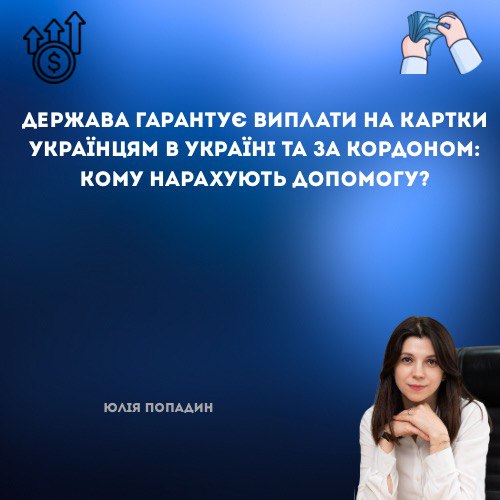
The state guarantees payments to the bank cards of Ukrainians in Ukraine and abroad

In 2025–2026, the state guarantees the provision of financial payments to bank cards of Ukrainian citizens both within the country and abroad. This is a new level of social support, covering pensions, benefits, international humanitarian aid, scholarships, childbirth payments, and many other forms of social assistance. The transition to cashless accruals through the accounts of Ukrainian banks is now the key standard, ensuring speed, accuracy, and security of funds. Who receives state assistanceThe government has officially announced that all social, pension, one-time payments, as well as international humanitarian aid, will be transferred solely to the cards of Ukrainian banks. This applies to the following categories: Pensioners and those not entitled to a pension; Low-income families; People with disabilities (all groups); Internally displaced persons (IDPs); Large families and single parents; Families of military personnel; Orphans and those who lost parents due to war; Parents of newborns; Youth (the “YeKnyha” payment). Payments to cards for Ukrainians abroadFor Ukrainians abroad, the state guarantees payments in hryvnia to cards of Ukrainian banks. Citizens who have been evacuated or are staying abroad can use funds through online banking, ATMs, and partner withdrawal networks in Europe.If the card is not active or expired, banks recommend its immediate renewal to receive future payments. After entering an EU country, the recipient continues to use their Ukrainian card. International organizations (UN, Red Cross) also provide humanitarian aid through Ukrainian accounts. One-time and seasonal paymentsIn autumn 2025, the following are provided: “Winter Support” program — 1000 UAH for each beneficiary; Payments for youth — 908 UAH for books under the “YeKnyha” program; UN or Red Cross grants — 200–250 euros per family; Compensation for moving or housing for IDPs.These funds are credited exclusively to card accounts, providing security and convenience. Categories and amounts of social paymentsEligible persons include: Low-income families (from 1816.8 UAH/month and above, depending on the minimum subsistence level); People with disabilities — from 2361 UAH per month; Children — 3716–4634 UAH depending on age and status; Youth — a one-time payment of 908 UAH.Payments are calculated based on insurance record, income level, social status, and family size. Payments via digital initiativesVia “Diia”, it is possible to submit applications for most aid. Processing requires a passport and a valid bank card. IDPs and other eligible groups may apply remotely, receiving funds to a card account.The national cashback program allows monthly returns from cashless purchases, promoting social guarantee digitalization and transparency of transactions. Restrictions and nuancesAll payments are made only in hryvnia. If the card is inactive, it must be replaced before applying. For those abroad, international aid is exclusively tied to Ukrainian bank accounts.Some EU countries in 2025 limit or cut local refugee aid (e.g., Germany for arrivals after April 2025), yet Ukrainian payments are not limited by the recipient’s location. Required documentsTo receive payments: Passport or ID card; Valid bank card; Application via the official “Diia” app, Pension Fund, or social protection office; Documents confirming status (certificates, IDs, birth certificates, IDP docs, etc.). Transparency and digitalizationThe state is reforming its digital and financial infrastructure, cooperating with international partners to establish automatic payment control and user rights protection. The introduction of open banking allows combining multiple cards for one recipient and implements stronger identification methods. Tips for recipients Check card expiration and renew if needed. Apply only through official services. Monitor new government decrees to optimize support receipt. Protect your bank and personal data. ConclusionThe state ensures a stable, clear, and transparent mechanism for social payments to all Ukrainians, regardless of location, status, or financial situation. Categories receiving aid—low-income, pensioners, IDPs, military, youth, children—are under special attention from the government and international partners. Author – Yuliya Popadyn, attorney in tax and customs law practice, WINNER Law Firm.If you have questions or issues regarding choosing the optimal program, protecting recipient rights, legal consultations on international payments, appealing state decisions, or preparing documents—contact our professional team for support. https://youtu.be/RlDOb-yR4MI?si=vjrvrvPtH32jYfxu

Без рубрики

New level of minimum pension — what awaits in 2026

Official Cabinet Proposal: Minimum Pension 2,595 Hryvnia.  In the draft state budget for 2026, 1,027 billion hryvnia is allocated for pension expenditures – representing approximately 19% of all state budget expenditures and the largest item of social welfare spending. This is 123 billion hryvnia more than in 2025. The Cabinet proposes to set the subsistence level for persons who have lost work capacity (including old-age pensioners and persons with disabilities) at 2,595 hryvnia. The government bases this on a forecast of consumer price growth of 9.9% in 2026. How this amount is calculated: 2,361 hryvnia × 1.099 = 2,595 hryvnia. Mathematically this appears logical and sound, yet this exact figure has sparked the most heated debates regarding real purchasing power and adequacy for living. Criticism from parliamentarians.  Danylo Hetmantsev, chairman of the parliamentary Committee on Finance, Tax and Customs Policy, sharply criticizes the Cabinet’s proposal, calling the 234-hryvnia increase “mockery of elderly people.” In his opinion, while defense is the budget’s first priority, people and their social support must be the second priority. Hetmantsev proposes an alternative budget with the following social indicators: Subsistence level – 4,700 hryvnia (instead of the proposed 3,209) Minimum pension – 4,700 hryvnia (instead of 2,595) Minimum wage – 12,000 hryvnia (instead of 8,647) According to him, this represents “the first step in a phased substantial review of payments to bring them closer to real necessary indicators.” Hetmantsev also emphasizes that the subsistence level should actually be a level on which one can truly live, not merely a mathematical construct in the budget. How maximum pension and other indicators will change.  In 2026, the maximum pension will increase from 23,610 to 25,950 hryvnia – equivalent to ten subsistence levels. The surcharge for extra service years will increase from 23.61 to 25.95 hryvnia per year. Ukraine’s minimum wage has not increased for two years, but in 2026 it is to rise to 8,647 hryvnia. This will directly affect pensions of citizens whose payments are tied to the minimum wage – specifically those aged 65 with full employment history (35 years for men, 30 years for women). Pension indexation in March 2026.  In addition to the base 234-hryvnia increase, the Cabinet has planned pension payment indexation starting March 1, 2026. The amount of indexation will depend on inflationary processes in the first quarter of 2026 and will be announced in February of the following year. For comparison: pensions were indexed by 14% in 2022, 20% in 2023, 8% in 2024, and 11.5% in 2025. Thus, 2026 indexation could serve as an additional source of pension payment increases beyond the base increase. Transformation of the pension system on the 2026 horizon.  Beyond simply increasing pension amounts, a serious transformation of Ukraine’s entire pension system is planned for 2026. The Ministry of Social Policy, together with international specialists, is working on updating the pension security model for citizens. Basic payment for senior citizens. The system will provide guaranteed basic payments for all persons who have reached age 65 (or 60 for certain categories) with full insurance history. This will create a sort of “social minimum” protecting the most vulnerable elderly populations. Transformation of special pensions. So-called special pensions for military personnel, law enforcement, and other categories will be converted to professional pension format. This should increase distribution fairness and unify the system. Bonuses for combat experience. Supplements will be introduced for combat participants and those with combat experience. This becomes especially relevant in the context of prolonged Russian aggression. Who specifically will be affected by the 234-hryvnia increase.  The 234-hryvnia increase will automatically affect the following retiree categories. Pensioners with service records whose payments are close to minimum will receive this increase. The minimum pension for persons with disabilities will also rise from 2,361 to 2,595 hryvnia – distribution depends on disability group. Those whose pensions depend on minimum wage will see more noticeable increases due to minimum wage growth from 8,000 to 8,647 hryvnia. At the legislative level, a guarantee principle is enshrined: even if during recalculation pension payments theoretically should decrease, individuals will still receive pensions at the previously established amount. This protects pensioners from possible payment reductions during difficult economic times. Comparison with European standards.  Even after the 234-hryvnia increase, Ukraine’s minimum pension of 2,595 hryvnia will remain among Europe’s lowest. For comparison, Ukraine’s average pension as of July 1, 2025, was 6,410 hryvnia. On average, developed European countries maintain minimum pensions ranging from 800 to 1,200 euros monthly (approximately 28,000 to 42,000 hryvnia at current rates). Even recently-joined EU member states have significantly higher minimum pension levels. This indicates Ukrainian pensioners’ material situation will remain strained even after the increase. Debate over real purchasing power.  A key argument by critics is that the 9.9% minimum pension increase fails to cover the actual cost-of-living increase for pensioners. Inflation affects different commodity groups differently. For elderly people spending significant income portions on medicines, utilities, and food, inflation often appears higher than average. Hetmantsev notes the subsistence level wasn’t reviewed during 2025, resulting in lost pensioner purchasing power. Practical recommendations for pensioners Verify insurance history. Contact the Ukrainian Pension Fund to verify proper recording of insurance service. Document entire work period. All labor books and employer orders must be available. Contact PFU if discrepancies exist. Errors should be corrected before retirement. Develop a budget plan. Review expenses considering the new minimum pension amount. Consider additional income sources. Those capable of working should explore supplementary earning opportunities. Conclusions For 2026, the Cabinet plans to increase the minimum pension by 234 hryvnia – from 2,361 to 2,595 hryvnia. While this increase satisfies indexation logic matching projected inflation, it drew parliamentary criticism regarding inadequacy. Beyond the base minimum increase, 2026 will see March 1 pension indexation, minimum wage growth to 8,647 hryvnia, and pension system transformation beginning based on fairness and adequacy principles.  Debate over minimum pension amount adequacy will continue until the state budget receives final parliamentary approval. Author – Yulia Popadin, lawyer, tax and customs law practitioner at the Attorney Association “Legal

Без рубрики

POS terminals for Group 1 sole proprietors in Ukraine will be mandatory from 2026—no postponement or delay of the requirement

From January 1, 2026, new rules will come into force in Ukraine for small businesses. Cabinet of Ministers Resolution No. 894 from July 29, 2022, introduces an obligation for self-employed persons (FOP) of the first group under the simplified tax system to provide the possibility of cashless payments through payment terminals. The business community is actively urging the Cabinet to consider postponing this requirement due to numerous challenges it creates for microentrepreneurs. Why business is asking for postponement The reasons why entrepreneurs insist on reconsidering the date for introducing payment terminals relate to practical, economic, and technical aspects. Economic burden for small entrepreneurs. FOP of the first group are the smallest participants in the economy. According to legislation, these are entrepreneurs who: have annual income up to 600 thousand hryvnias (exceeding the limit requires moving to another group); do not employ workers; work mainly independently at markets, in kiosks, in mobile trade format. For such entrepreneurs, even small additional expenses are significant. Acquiring commissions range from 0.5% to 2.5% of the amount of each transaction, which directly reduces profit. At an annual turnover of 600 thousand hryvnias, even a 1% commission means a loss of 6 thousand hryvnias. Internet connection problems. Many sales points, especially in villages, markets, and small towns, suffer from unstable or slow internet. Payment terminals require stable connectivity to operate. At crowded markets with many people, technical failures can lead to queues and customer loss. Loss of elderly customers. Pensioners at markets often lack bank cards and distrust cashless payments. For many, this will be a serious obstacle to making purchases. The seller faces a situation where they must either refuse such customers or lose part of their customer base. Complexity of organizing small points. When a seller works “from hand” (corn at the beach, flowers near the metro, a fisherman selling catch), the question arises: where to place the terminal and how to organize payments. Mobile acquiring through a smartphone theoretically solves the problem, but requires a gadget, stable internet, and digital skills. Martial law. Part of the potential users of this rule, especially in regions near the front or on the periphery, are in combat zones. The requirement is introduced without full consideration of martial law realities and economic instability in certain communities. What Resolution No. 894 provides Resolution No. 894 established a phased introduction of the obligation to ensure cashless payments: Phase 1 (from January 1, 2023):traders in cities with population over 5 thousand residents. Phase 2 (from January 1, 2025):traders in settlements with population under 5 thousand residents. Phase 3 (from January 1, 2026):FOP of the first group, traders through vending machines, mobile traders, sellers of self-grown products. The logic of the resolution is simple: if a business accepts cash, it must have the ability to accept cards as well. In practice, however, for small entrepreneurs, this rule raises far more questions than answers. What alternatives to payment terminals exist The law does not require installing specifically a classic POS terminal. FOP can choose from several options: POS terminal from a bank. A traditional solution – renting or purchasing a terminal. Commission of 0.5–2.5% depending on the bank and transaction volume. Mobile acquiring (Tap to Phone). A small device connected to a smartphone, or the smartphone itself as a terminal. Convenient for mobile trading. QR codes for payment. A QR code is placed at the trading point, which the customer scans in a banking app. The tax service confirmed that this method meets the requirements of the resolution. Payment links. The seller sends the customer a link via messenger or SMS, and the customer pays online. Transfer to FOP account. The simplest option – when the customer makes a transfer to the entrepreneur’s bank account. In theory, these tools allow compliance with the law. In practice, however, most of them require internet, a smartphone, and basic digital literacy, which many first-group entrepreneurs lack. Why the Cabinet did not postpone the requirement Despite numerous appeals from business associations, unions, and individual FOPs, the Cabinet left the effective date of the rule unchanged – January 1, 2026. The reasons are rather strategic than tactical. Fighting the shadow economy. Cashless payments are the first step toward legalizing small business operations. A significant portion of transactions currently occurs “in the shadows” without being reflected in reporting. Increasing tax revenues. Each transaction through a terminal leaves a digital trail. This allows fiscal authorities to realistically assess sales volumes rather than relying on conditional indicators. Compliance with global practices. In many countries, even small traders have the ability to accept cards. Ukraine seeks to integrate into the European economic space and follow these standards. Development of digital infrastructure. The requirement for terminals is part of a broader strategy for digitizing the economy for 2025–2027. Penalties for non-compliance The Cabinet backed the new requirement with substantial sanctions: for violation of consumer rights – a fine of 8,500 hryvnias for restricting a customer’s right to choose payment method; for failure to comply with cashless payment requirements – a fine from 1,700 to 17,000 hryvnias; in case of repeated violations, fines accumulate, with the maximum amount reaching 25,670 hryvnias. The tax service has already warned that oversight will be active. The mere fact of the absence of cashless payment capability at a trading point can serve as grounds for imposing a fine – even without proven customer complaints. Practical recommendations for FOP of the first group Since there is little chance of deadline postponement, entrepreneurs should begin preparation now. Choose an optimal solution.You don’t necessarily need to buy an expensive stationary terminal – consider mobile acquiring, QR codes, or transfers to your account. Test the system in advance.At least six months before the deadline, start accepting cashless payments in test mode. Choose a reliable partner.Compare offers from banks and payment services by commission rates, contract terms, speed of fund transfers, and support. Inform customers.Place stickers and announcements about the possibility of card payment, especially focusing on an older audience. Train yourself and assistants.If family members are involved in the business, explain to them the

Без рубрики

How much tax do TikTok bloggers pay

In November 2025, the Ministry of Finance and the State Tax Service of Ukraine launched the information campaign “Taxes Protect,” aimed at simply explaining to Ukrainians the tax rules for different types of income. The first thematic material focused on social media bloggers—a profession that in recent years has turned from a hobby into a serious source of income for millions of Ukrainians. Using the example of 22-year-old TikTok blogger Maria, officials demonstrated exactly how much tax content creators should pay. Example of Maria: a typical TikTok bloggerMaria runs a popular TikTok blog and advertises Ukrainian and international brands. Her average monthly income is 60,000 UAH, which is 720,000 UAH per year—a perfectly realistic figure for a mid-level blogger with a stable audience. To work legally, she registered as an individual entrepreneur (FOP) of the third group under the simplified taxation system, which allows her to officially provide advertising services, receive payments from any companies, benefit from simplified taxation, and legally withdraw funds. Each quarter, Maria submits a declaration via the “My Taxes” mobile application and pays the required taxes and a single social contribution. Three taxation options for bloggers: comparisonAs of 2025, Ukraine has three main ways to legalize bloggers’ income, each with its own advantages, disadvantages, and limitations.Option 1: Individual without FOP. This is the most expensive option—a blogger pays 18% personal income tax (PIT) and 5% military levy, totaling 23% of gross income. With 720,000 UAH in income per year, taxes amount to 165,600 UAH. The declaration is submitted once a year by May 1st. This is the simplest option in terms of registration, but the least profitable in terms of tax burden.Option 2: FOP of the second group. Fixed payments for 2025: 1,600 UAH (single tax) + 800 UAH (military levy) + 1,760 UAH (USC) = 4,160 UAH per month, or 49,920 UAH per year. This means 70% savings compared to being an individual. Reporting is annual. However, this option is only suitable for cooperation with Ukrainian partners. Restrictions: maximum annual income of 6,672,000 UAH; can’t work with large brands on the general taxation system; can’t receive income from abroad (e.g., AdSense, Patreon, foreign brands).Option 3: FOP of the third group (Maria’s choice). This group pays percentage-based contributions: 5% single tax from income, 1% military levy from income, and a fixed USC of 1,760 UAH per month. With 720,000 UAH per year, the calculation is as follows: 36,000 (5% single tax) + 7,200 (1% levy) + 21,120 (USC) = 64,320 UAH. This is 61% savings compared to being an individual. Reporting is quarterly—four declarations per year. Max income is 9,336,000 UAH per year. Main advantage: can work with any clients—Ukrainian companies under the general system, foreign brands, monetization platforms like YouTube AdSense, Patreon, donation services, and payment systems like Payoneer, Wise, PayPal. Consequences of tax evasionIgnoring tax payment requirements is not just a legal violation. Bloggers risk serious penalties:Criminal liability. Under Article 212 of the Criminal Code of Ukraine, tax evasion can result in up to 6 years in prison, being barred from certain activities for up to 2 years, and confiscation of property.Financial monitoring. Banks actively cooperate with tax authorities and pass information about “suspicious” deposits to individuals’ cards. In 2025, it is nearly impossible to hide income—the system automatically monitors large sums.Loss of social guarantees. Without regular USC payments, bloggers do not accumulate insurance history: this means no rights to sick pay, maternity payments for women, future pensions, or unemployment assistance.Inability to work with large brands. Serious companies only work with officially registered FOPs, as it simplifies their accounting and reduces tax risks. If you’re not an FOP, you lose the most profitable contracts. Tax specifics for different income typesA blogger’s income can come from various sources, each with their own peculiarities.Advertising integrations from Ukrainian and international brands. Requires a 3rd group FOP with taxation: 5% single tax + 1% levy + USC.YouTube AdSense. Income from video monetization is considered foreign income; a 3rd group FOP is required, standard tax scheme applies.Donations from viewers. This is the trickiest case. Donations are not FOP income (it’s not payment for services, but voluntary giving), but are taxed as individual income—18% PIT + 5% military levy = 23%. Bloggers are advised to keep flows separate: advertising income to a FOP account, donations to a personal account with an annual declaration.Sale of merchandise, courses, consultations. 2nd group FOP (if selling to individuals) or 3rd group (if to large companies or via international platforms). Practical tips Don’t wait for the tax office to find you. Even 500 UAH per month must be declared. Excuses don’t work. Choose the right FOP group. FOP 2—for working with only Ukrainian audiences. FOP 3—for international partnerships and large brands. Keep clear records of income. Keep contracts, invoices, and bank statements—this protects you from tax claims. Use the “My Taxes” app. The app makes it easy to file declarations, pay taxes, and check settlements. Consult with tax experts. The law changes often. Receive income into the FOP account. All business funds should be received there, not on a personal card. ConclusionsA FOP of the third group with an annual income of 720,000 UAH pays 64,320 UAH in taxes—just 8.9% of income. Compared to working as an individual (23% taxes), this is a 61% saving. At the same time, the blogger can legally work with Ukrainian and international brands, accrues insurance history with rights to social benefits, has a transparent income record for loans and visas, and is protected from criminal prosecution. Author: Yulia Popadyn, tax and customs law attorney, WINNER Law Firm. If you have questions or problems with financial monitoring, protecting bank accounts from unlawful blocking, appealing bank actions, consulting on legitimate business operation, or understanding tax monitoring and anti-money laundering laws—contact the team of professionals in tax and financial law. https://youtu.be/k2-1dq7hxcY?si=HzAuhrfWxPd7qmdP

Без рубрики

The NBU fined RozetkaPay and Portmone Group 21.4 million UAH for systemic violations in the payment services sector

In November 2025, the National Bank of Ukraine (NBU) published a decision on imposing significant financial sanctions on two non-bank financial institutions — LLC “FC EVO” (RozetkaPay) and LLC “FC MBK” (Portmone Group). Following scheduled inspections of these payment services in 2025, the regulator imposed fines totaling UAH 21.4 million and issued written warnings regarding internal control and the organization of the companies’ operations. Reasons for Imposing Fines According to NBU and independent sources, RozetkaPay was fined UAH 13.6 million for a series of violations in cash transactions, client account management, information security, issuance and acquiring of payment instruments, as well as deficiencies in client contracts. The inspection was conducted between June and August 2025, allowing the regulator to identify systematic flaws in the company’s processes, namely: Violations of client account management requirements: improper transaction documentation, payment delays, issues with account balances. Insufficient protection of personal data and financial information of users, creating risks of unauthorized access. Issues with issuance and maintenance of payment cards and other instruments, affecting consumer protection. Deficiencies in legal contract structures for client interaction: unclear service terms, lack of transparent compensation and service liability provisions. Portmone Group, 100% owned by Kaspi Pay LLC (Kazakhstan), holds an NBU license for money transfers without opening accounts. An audit in March–May 2025 revealed violations concerning the issuance of payment instruments, client data storage, and compliance with prudential regulations, resulting in a fine of UAH 7.8 million. Additionally, the company received a written warning for shortcomings in information disclosure, internal control, corporate governance, and documentation. Legal Basis and Regulatory Context NBU’s decisions are based on the requirements of the Law of Ukraine “On Payment Services,” as well as consumer protection standards in the financial sector and prudential regulations. For non-bank financial institutions, comprehensive control over compliance with operating standards is increasingly important: Mandatory consumer notification regarding contract terms, tariffs, and restrictions. Personal data protection according to GDPR and Ukrainian law. Introduction of strict criteria for internal audits, risk management, and transaction documentation organization. In 2024, RozetkaPay demonstrated rapid financial growth: revenue increased 2.5 times (UAH 899.54 million), net profit grew 1.5 times to UAH 16.69 million. Portmone Group for the same period received a net profit of UAH 30.09 million, which is only 3% less than in 2023. Impact on Market and Services The imposition of fines on leaders of Ukraine’s payment services market has multifaceted consequences: Higher transparency and compliance demands for every market entity, especially regarding information security and legal service support. Owners and top management must revise corporate governance policies, invest in internal audits and compliance. Increased focus on customer service standards, both online and offline, legal process automation, and enhanced consumer rights protection. “Warning effect” for other market participants: a wave of internal audits, compliance investments, and legal due diligence is expected. Potential strengthening of state control may spur the integration of new security technologies (KYC, AML, multi-level data verification, encryption). For the companies themselves, fines mean not only financial payments, but also radical restructuring of procedures: contract documentation audits, data processing policy updates, modernization of IT systems for information security guarantees. Judicial and Administrative Perspective According to NBU decisions, companies must pay the fines within 14 calendar days of receiving the committee’s decision and rectify all violations by December 17, 2025. If these requirements are not met, administrative proceedings may be initiated, with additional sanctions — up to temporary license suspension or restriction of certain activities. Challenging the regulator’s actions in court remains common in the legal field, but the evidence and justification provided by the NBU committee in the cases of RozetkaPay and Portmone Group suggest strong prospects for the regulator to prevail in administrative proceedings. Legal Commentary on Impacts Given current trends in the digitalization of Ukraine’s payment market, the RozetkaPay and Portmone Group cases illustrate key risks for non-bank institutions: insufficient compliance control, neglect of legal changes, formal attitudes to personal data protection and contractual procedures. For lawyers and financial service executives, this case is an example of the necessity for ongoing legislative monitoring, comprehensive internal control policies, and legal support. Conclusions The fines against RozetkaPay and Portmone Group mark a significant episode in the new phase of state oversight of Ukraine’s payment market, reinforcing requirements for transparency, safety, consumer protection, and corporate governance. For market competitors, this is a stimulus to invest in compliance, legal audits, and consumer rights protection. For legal support teams, it highlights the importance of developing standardized contracts, data protection policies, and consulting on new regulatory requirements. Author: Ihor Yasko, Managing Partner of WINNER Law Firm, PhD in Law. https://youtu.be/k2-1dq7hxcY?si=HzAuhrfWxPd7qmdP

Без рубрики

Cashless Payments for Self-Employed Persons from 2026: Who Will Be Affected by the New Requirement

In Ukraine, from 2026, the mandatory requirement for accepting cashless payments will be expanded for entrepreneurs. Previously, this applied only to private entrepreneurs (FOPs) in cities, but from 2025 — in all settlements. Starting from 2026, the obligation to install POS terminals or other cashless payment methods applies to all FOPs, even those in the 1st tax group and sellers of their own products. The two-year transition period ends, and everyone who sells goods or provides services to the public must offer the ability to pay by card or electronically. Who Is Subject to the New Requirements Resolution No.894 from 2026 requires acceptance of cashless payments from: FOPs in the first single tax group (up to 1.167 million UAH income, without hired employees) — market vendors, kiosks, craftsmen, minor services; Traders and entrepreneurs engaged in street, traveling, retail trade, fairs, seasonal or beach trade; Sellers of self-grown or self-produced products (farmers, pensioners with harvests, sellers of honey and homemade cheese); Entrepreneurs using vending machines (coffee, snack, ticket, parking machines) — payment must be via a terminal/QR code integrated into the device.The requirement covers not only stationary, but also remote sales with courier delivery. If the consumer pays on the spot, the FOP is obliged to enable card payment. Exceptions: Who Is Exempt Entrepreneurs operating in temporarily occupied territories and combat zones (per the Ministry of Reintegration list) — until de-occupation or cancellation of status; Businesses registered in settlements officially recognized as combat zones.During inspections, documents or certificates confirming the business location in such zones must be provided. Types of Cashless Payments A classic POS terminal installation is not obligatory. The following can be used: POS terminal (standard bank terminal, rented or purchased); Mobile acquiring (connecting a card reader to a smartphone/tablet); QR code for payment via banking application; Banking and payment applications generating payment links or QR codes; Online payment link in a messenger — for remote sales.The main requirement is that the buyer must be able to pay for goods or services by card or electronic means. Penalties for Non-Compliance For failing to provide cashless payment options: Fine for violation of consumer rights — 8,500 UAH (Art. 23 of the Law “On Consumer Protection”); Fine for non-compliance with cashless payment requirements — from 1,700 to 17,000 UAH (Art. 163-15 of the Code of Ukraine on Administrative Offenses); Fine for violation of trading rules — 17 to 170 UAH (Art. 155 of the Code of Administrative Offenses); The maximum total penalty for repeated offenses can reach up to 25,670 UAH.Supervisory authorities may impose fines regardless of whether the FOP refused service to the client — simple failure to comply is sufficient. Prohibitions and Obligations It is forbidden to force the buyer to pay only in cash or only by card; It is forbidden to charge an extra fee for card payment — all costs are borne by the entrepreneur; The price of goods or services must be the same for all payment methods; Bonuses or promotions may be used to encourage cashless payments. Purpose Combating the shadow economy, reducing money laundering; Increasing fiscal revenue — all transactions pass through banks; Transparency for consumers: electronic receipts, statements, protection of rights in case of disputes; Alignment with global digitization trends. Practical Advice for FOPs Choose the optimal method for your business (terminal, QR, mobile acquiring). Compare bank fees and select the best offer. Ensure your location is not on the exemption list. Prepare the sales point: access to the Internet, power supply. Train employees/relatives on terminal use. Inform clients about the possibility of paying cashlessly. Automatically keep track of transactions via account statements. Conclusions For FOPs in the first tax group, mobile traders, and sellers of agricultural/domestic products, from 2026 — the requirement to accept card or electronic payments becomes mandatory. Preparation, investment in equipment, and mastering new services will be required, but this brings new benefits — transparency, safeguarding interests, appeal to modern consumers. Ignoring the requirement means risk of fines up to 25,000 UAH and administrative actions. Author – Yuliya Popadyn, tax and customs law attorney, WINNER Law Firm.If you have any questions or issues related to choosing the optimal cashless payment method for your business, interpretation of Resolution No.894 requirements, protection against unfounded fines by controlling authorities, contesting decisions on administrative sanctions, entering into acquiring agreements with banks on favorable terms, keeping tax records of cashless transactions, consulting on the application of different payment systems — contact a team of professionals in the field of tax and customs law. https://youtu.be/k2-1dq7hxcY?si=HzAuhrfWxPd7qmdP

Без рубрики

Land shares: how to keep your ownership rights until 2028

Millions of Ukrainians who received land shares during the division of lands from former collective agricultural enterprises face the danger of losing their property forever. The state land reform program has set a clear deadline: by January 1, 2028, all owners of land shares must register ownership rights. If they fail to do so, the land will be confiscated, declared abandoned, and transferred to the communal property of territorial communities. Over 104,400 unclaimed land shares remain unprivatized. Why the State Needs Land Privatization Increasing the tax base. Unprıvatized land is not recorded in registers as private property, so the state cannot fully tax this land. When land officially transitions to private ownership, it becomes subject to land tax. Thousands of hryvnias in annual taxes will flow into local budgets. Developing the real estate market. Unprıvatized land cannot be sold, gifted, or pledged as collateral for a loan. When land is privatized, it becomes an asset for investments, business, or sale, promoting economic growth in rural areas. Preventing corruption. If land shares remain unprıvatized, they can become targets of corruption. When land is officially privatized and registered, such manipulations become significantly more complicated. Strategic importance. Land is Ukraine’s most important natural resource. The state needs complete and transparent information about all land plots for strategic development planning, land use control, and environmental monitoring. Final Deadline: January 1, 2028 The law clearly sets the deadline – by January 1, 2028, all owners of unclaimed land shares must register ownership rights. Previously, the deadline was set for January 1, 2025, but was extended by three years due to military operations. This was a necessary concession since people from occupied territories, mobilized individuals, and displaced persons had objective reasons not to register rights on time. However, after January 1, 2028, the law will not negotiate further. What Happens After the Deadline If an owner of an unclaimed land share does not register ownership by January 1, 2028: Recognition of abandonment. That person will automatically be considered as having abandoned the land plot – without needing to submit a statement. Transfer to communal ownership. The land will be transferred to the communal ownership of the territorial community (OTG or city) where the plot is located and will cease to be private property. Seven-year moratorium. The law establishes a moratorium (until January 1, 2035) on transferring this plot to private ownership of other persons, except for transfer to the original owner or their heirs. Theoretically, the original owner can reclaim their plot within seven years if they prove their ownership rights. Loss of control. After that, the territorial community can use the land at its discretion: lease it, develop public facilities, or transfer it through auctions to other persons. How to Register Ownership Rights to a Land Share The process of registering ownership rights to a land share is an achievable task if you act systematically: Find documentation about the share.You must find the original certificate of ownership rights to the land share. If it’s missing, contact the archives of local government bodies. Find a land surveyor.Contact a land surveying organization that will develop documentation for determining plot boundaries in kind. Geodetic work.A geodesist will conduct a survey of the territory and develop a plot plan with exact coordinates and boundaries. Registration with the local authority.Submit documents for plot allocation in kind and obtain a decision on allocation. Cadastral registration.Documents are transferred to the administrative services center (ЦНАП) for cadastral registration, where the plot is assigned a cadastral number. Registration of ownership rights.Submit an application to ЦНАП or the e-Land platform to register ownership rights in the Register of Rights to Real Property. The entire process may take from several months to a year depending on the complexity of the situation and the quality of work by the organizations involved. Special Exceptions and Deadline Extensions The law provides special exceptions for people who could not register ownership rights on time due to objective circumstances: People who were mobilized or participated in combat operations People who were internally displaced due to occupation People who were in temporarily occupied territories People whose place of residence was in a zone of active combat For these categories, it is possible to extend the deadline for registering ownership rights if documents confirming their special status are provided. Categories of People Most Affected Elderly people. Pensioners often do not understand the complexity of administrative procedures and pass away without registering their rights. Their heirs are left with an unresolved problem. Emigrants. Many Ukrainians who emigrated abroad have forgotten about their land rights. For them, registration requires special procedures through diplomatic institutions. People from occupied territories. Those who fled occupied territories often lost their original documents. Registration requires court procedures or special document recovery procedures. People who don’t understand the procedures. Many people simply don’t know how to register ownership rights, where to turn, or what documents are needed. Heirs. If the original owner of the land share has died, heirs must first register a certificate of inheritance rights, and then register rights to the plot, which doubles the time and complexity. Practical Recommendations Check if you have a land share.Contact the administration of your OTG, village, or city with a request about the availability of an unclaimed land share. Don’t wait until the last day.The process takes time. Start immediately, ideally no later than 2027. If you are an emigrant, contact a representative.The law allows you to authorize a representative with a notarized power of attorney. Collect documentation about deadline extension.If you have objective reasons for extension, submit an application and obtain written confirmation from local government authorities. Use the services of a lawyer.If the procedure seems complicated, hire a lawyer specializing in land issues. Check the registration status.After registration, verify that the data has been correctly entered into the Register of Rights. It’s better to identify and correct errors immediately. Future: Value of Released Land The value of land in Ukraine has increased sevenfold over the past two years. Land that was previously considered worthless can now cost thousands of hryvnias per hectare.

Scroll to Top