Потрібна допомога адвоката?
Залишай заявку
VAT from the first euro: government re-approves taxation of parcels up to €150
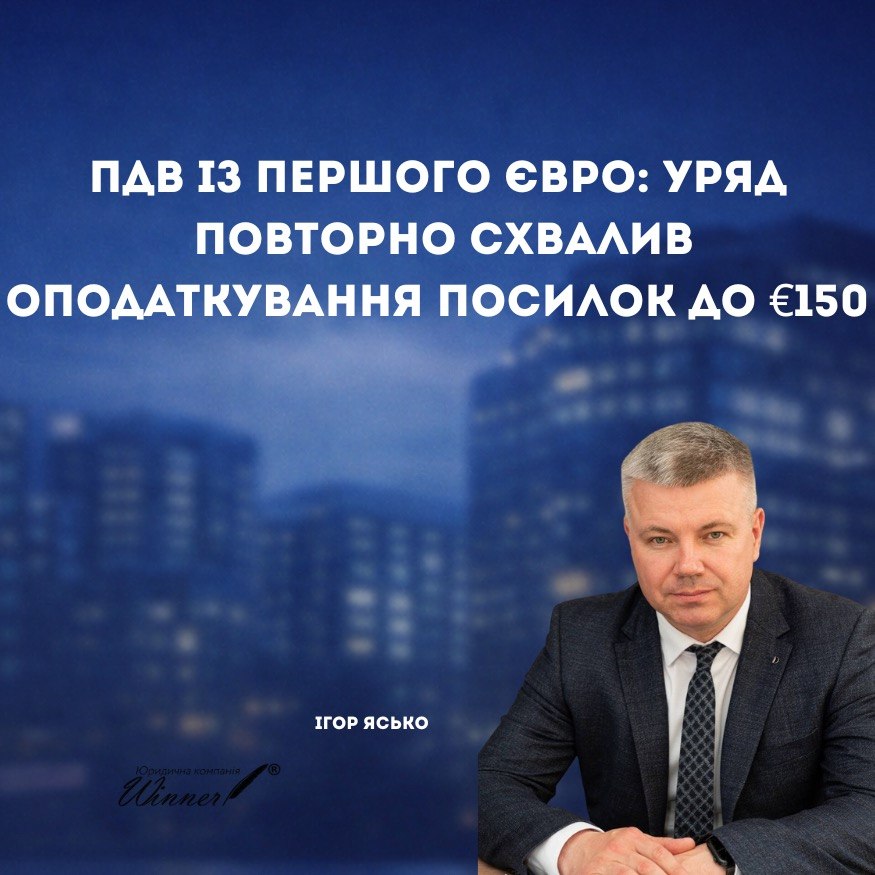
The familiar arrangement of ordering goods worth up to €150 from a foreign marketplace and receiving them in Ukraine VAT-free may stop working.
On 7 September, the Cabinet of Ministers re-approved a package of draft laws introducing a new model for taxing international parcels.
The key change is that, for goods purchased through foreign marketplaces, the current exemption for parcels worth up to €150 is proposed to be effectively abolished, with VAT charged from the first euro.
The rate would be 20%.
In other words, a product priced at €100 could potentially carry an additional €20 in VAT.
However, the mechanism is designed so that buyers would not need to visit customs authorities or complete declarations themselves.
VAT would be charged directly when the purchase is completed on the marketplace and included in the product’s final price.
The marketplace would be responsible for remitting the VAT to the Ukrainian budget.
If the platform is a non-resident, it would need to operate through a legally prescribed representation or intermediary mechanism in Ukraine to fulfil its tax obligations.
In effect, Ukraine is moving toward an IOSS-style model already used in the European Union.
For buyers, the process should be simple:
see the price → pay VAT immediately → receive the parcel without additional tax formalities.
However, the reform has much broader implications for businesses.
Today, a Ukrainian store that sells a product for UAH 1,000 generally operates under Ukrainian tax rules.
At the same time, an equivalent product can be ordered through a foreign marketplace in a parcel worth up to €150 using the current exemption.
This is the difference the Government intends to eliminate.
There is another issue as well: splitting commercial consignments into many small parcels worth up to €150 in order to use the preferential regime.
Once the new model is introduced, the economic rationale for this arrangement should decrease substantially.
At the same time, not all international shipments are proposed to be taxed.
In particular, the exemption for non-commercial person-to-person parcels worth up to €45 is expected to remain, subject to conditions established by law.
A separate regime will also remain for goods in unaccompanied baggage worth up to €150.
For Ukrainian e-commerce businesses, importers, and retailers, this could be a significant change in the competitive landscape.
For foreign marketplaces, it would create new tax and administrative obligations in Ukraine.
For buyers, it would mean an effective increase in the cost of some purchases that currently benefit from the exemption.
But it is important to note: VAT from the first euro is not yet in force.
These are proposed legislative changes that must still complete the parliamentary procedure.
The launch of the new system also depends on the readiness of customs and marketplace IT infrastructure. Therefore, businesses should not panic, but should prepare in advance.
Importers, marketplaces, and online stores should assess how the new model may affect:
– the cost of goods;
– pricing;
– import models;
– VAT;
– customs clearance;
– work through foreign marketplaces;
– the competitiveness of Ukrainian and imported goods.
In international trade, a change in one tax rule can sometimes completely transform the economics of a business model.
It is better to seek legal advice now than to need legal defence services later.
Would you like legal advice on imports, VAT, international e-commerce, or restructuring your business model for the new rules?
📞 Call: 096 574 81 02
📧 Email: info@uk-winner.com
Author: Ihor Yasko, Managing Partner at WINNER Law Firm, PhD in Law.
Потрібна допомога адвоката?
Залишай заявку

- Усі права захищені