Потрібна допомога адвоката?
Залишай заявку
AMCU fines businesses more than UAH 133 million for bid rigging
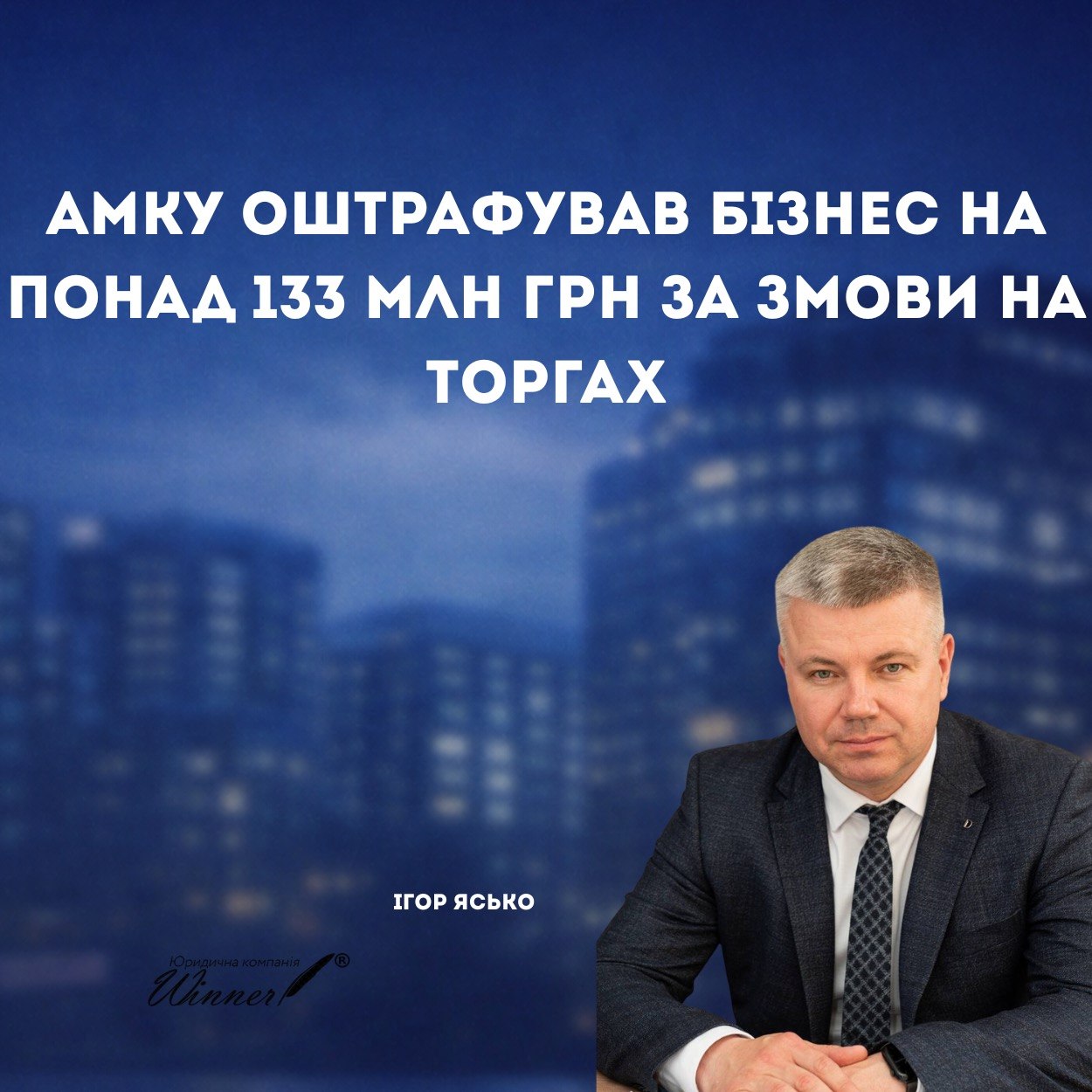
One day — six decisions of the Antimonopoly Committee of Ukraine (AMCU) and more than UAH 133 million in fines for businesses.
On 8 September, the AMCU reported the results of its review of several cases involving anticompetitive concerted actions during tenders and auctions.
The largest fine — UAH 110 million — was imposed on two companies for five violations in electricity supply tenders.
The expected value of those procurements exceeded UAH 1.5 billion.
But this was far from the only case.
The AMCU also established violations involving:
– the procurement of meters for an energy company;
– 11 tenders for cable products;
– the privatization of an alcohol-production facility;
– the sale of an integrated property complex of a state-owned enterprise;
– a land auction.
In certain cases, the participants themselves acknowledged the violation of competition law.
What does this mean for business?
Bid rigging does not necessarily mean that two directors met and signed a written agreement on who would win.
The AMCU assesses the overall set of circumstances and facts that may indicate coordinated conduct by bidders and the effective elimination of competition.
Therefore, business relationships that appear ordinary at first glance may create risks, including:
– shared employees or former employees;
– commercial and financial relationships;
– identical or similar documents;
– shared means of communication or technical infrastructure;
– unusual conduct during a tender;
– information exchange between participants;
– other facts that, taken together, the AMCU may regard as coordination.
And a fine is not the only risk.
If a company is held liable for anticompetitive concerted actions that distort tender results, this may become grounds for excluding it from public procurement procedures for three years.
For a company that earns a significant share of its revenue from public procurement, the consequences of such a decision may be far more costly than the fine itself.
Therefore, before related companies — or even companies whose owners or managers simply know each other — participate in the same tender, they should assess more than just the tender documentation.
The review should be broader:
who the owners are → who the employees are → what payments exist between the companies → how documents are prepared → who has access to information → how bidders behave during the auction.
What may appear to a business owner as ordinary commercial interaction can, when combined with other evidence, become an AMCU argument in a case concerning anticompetitive concerted actions.
Today, the cost of this risk is measured not in thousands, but in tens of millions of hryvnias — as well as in the ability to continue operating in the public procurement market.
It is better to seek legal advice now than to need legal defense services later.
Would you like to assess your company’s tender risks, or do you need representation in an AMCU case concerning anticompetitive concerted actions?
📞 Call: 096 574 81 02
📧 Email: info@uk-winner.com
Author: Ihor Yasko, Managing Partner at WINNER Law Firm, PhD in Law.
Потрібна допомога адвоката?
Залишай заявку

- Усі права захищені