Потрібна допомога адвоката?
Залишай заявку
The Mudra case: why article 209 of Ukraine’s criminal code is among the most difficult to prove
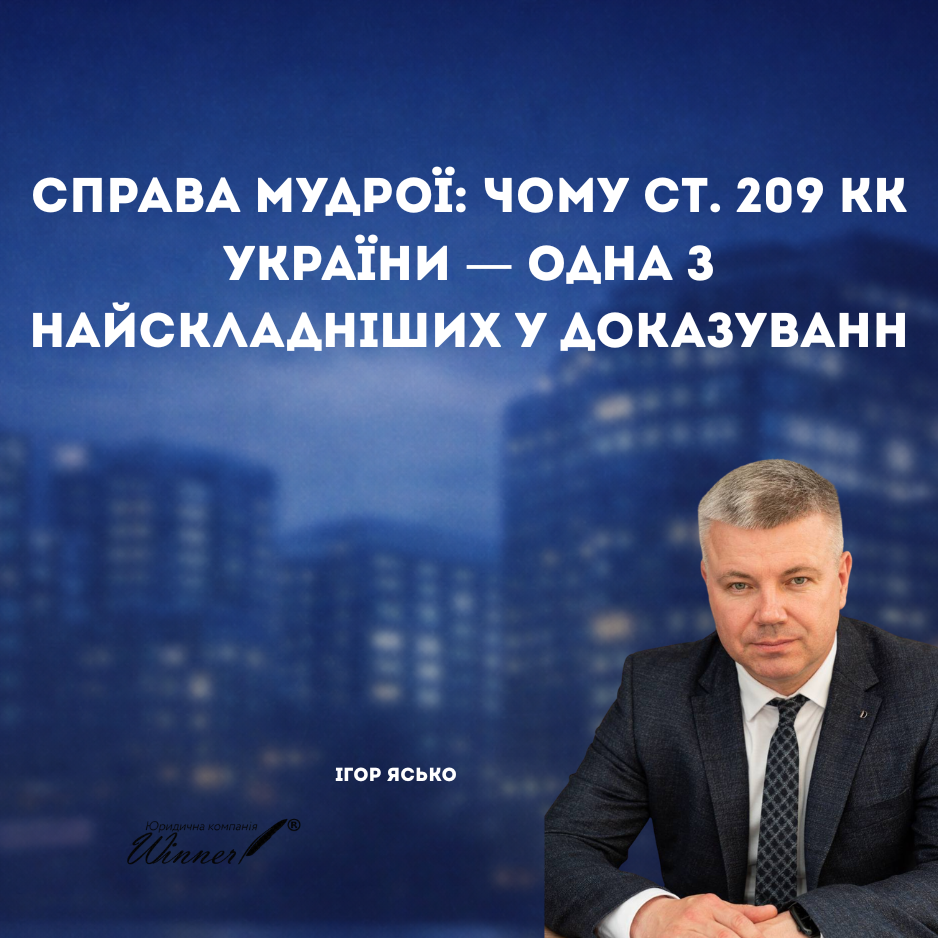
There are many sensational headlines surrounding the case of Iryna Mudra today. However, as a lawyer, I would not rush to draw conclusions based solely on the publicly disclosed investigation materials.
Article 209 of Ukraine’s Criminal Code — the legalisation of property obtained through criminal means — is one of the most complex categories of criminal proceedings, particularly in terms of proving the case.
For the prosecution, it is not enough to demonstrate the movement of funds, their deposit through banking institutions, the use of intermediaries, or even a complex system of financial transactions.
The key issue is the criminal origin of the property and proof that a specific person knew, or should have known, about that origin.
In practice, the prosecution must build a coherent chain of evidence: establish the origin of the funds, the circumstances in which they were obtained, their subsequent movement, the role of a particular person, and that person’s subjective attitude towards the relevant transactions.
This is where the most difficult part begins.
A financial transaction in itself is not money laundering. The movement of funds is not money laundering either. Acquaintance or communication between the individuals involved also does not, by itself, prove intent to launder money.
Published audio recordings and other materials may create a strong impression in the public sphere. However, criminal proceedings operate under different rules.
The court must assess the lawfulness of obtaining and the admissibility of each piece of evidence, the context of conversations, the body of evidence as a whole, the actual role of each person involved and, especially important for Article 209 of Ukraine’s Criminal Code, whether the required subjective element of the criminal offence has been proven.
Therefore, there can be a significant legal distance between a high-profile suspicion under Article 209 of Ukraine’s Criminal Code and a conviction.
It is the court — not media headlines or publicly disclosed fragments of investigation materials — that must make the final determination of guilt.
Until then, the presumption of innocence applies.
In criminal proceedings, a properly chosen defence strategy from the first days often determines the subsequent outcome of the case.
You can seek legal advice now rather than needing legal representation later.
Author: Ihor Yasko, Managing Partner at the WINNER Law Firm, PhD in Law.
Потрібна допомога адвоката?
Залишай заявку

- Усі права захищені