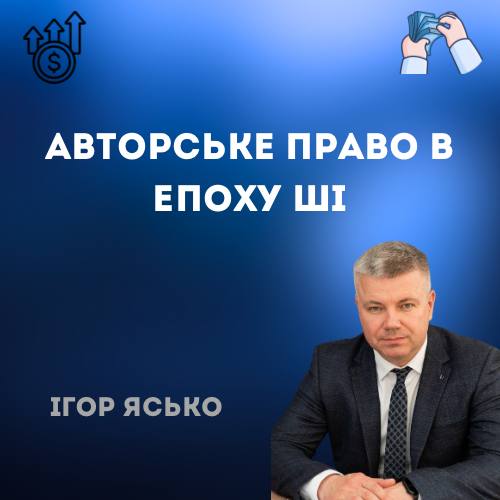
Copyright in the Age of Artificial Intelligence
Copyright reform in the era of artificial intelligence has already become a key topic for intellectual property professionals, IT businesses, and legislators. Modern regulations adopted in the EU in August 2025, as well as international legal and expert practices, require a revision of many traditional approaches to the protection, use, and allocation of rights to works created or modified with the help of AI. Ukraine is actively integrating into the European legal space, including in copyright matters—synchronizing legislative changes with EU trends and relevant reform projects.
Evolution of approaches: authorship and AI works
Traditionally, under Ukrainian and international law, only a human is recognized as an author. The Law “On Copyright and Related Rights” establishes this as one of the fundamentals of legal status: an author is a natural person whose work resulted in the creation of the work. The majority of countries (the US, EU, Australia, etc.) follow this logic. Meanwhile, the UK and China are experimenting with approaches in which the copyright for works generated using AI belongs to the person who initiated the relevant algorithms or to the rights-holding company. In practice, if a person provides a creative input in the content generation process, such a work can be protected by copyright—as the result of human intellectual activity.
Legality of training AI on protected content
AI training is based on processing large volumes of data, often protected by copyright—texts, images, and videos. In many countries (the US, EU), “exceptions” have already been formed or are being developed for such situations: in the EU, TDM exceptions (text and data mining) are in place for the automated analysis of works by research or commercial centers, with the right for a rights holder to prohibit the inclusion of their works in this activity through an opt-out mechanism. In Ukraine, there are currently no specific exceptions for AI training on protected works—the issue is considered on a case-by-case basis and needs additional legislative regulation. Apart from exceptions at the fair use level in the US, the law recognizes non-commercial and transformative uses as legitimate, but only within clearly defined bounds.
Presumption of liability: who is responsible for violations
A major legal issue is determining who is responsible for violations committed with the help of or directly generated by AI. Current practice suggests this gradation:
– AI developer—if no measures were taken to prevent violations or risky behavior was modeled;
– AI user—if the generated content is used for profit or third-party rights are knowingly violated;
– The AI itself—currently theoretical, since it lacks legal status; liability is placed on the developer or user.
Given the complexity and novelty of the situation, detailing the allocation of responsibility at the legal level is necessary, including introducing liability insurance mechanisms for AI companies and mandatory AI-content labeling.
European legislative standards and Ukraine
Since August 2025, the EU has new transparent rules for AI developers: mandatory disclosure of model training sources, creation of registries of high-impact models, and stricter conditions for GPAI (General Purpose AI). EU laws are introducing the world’s first special Codes and mechanisms for reducing regulatory burdens for responsible developers who sign an ethical code. Ukraine has already undergone several rounds of copyright harmonization with the EU, is fully integrating the DSM (Digital Single Market) Directive, and is analyzing the European experience with text and data mining. However, some gaps remain: the issue of AI-generated content, the balance of interests between authors and business, remains unresolved.
Prospects for legislative reform
The current challenges and opportunities created by AI development demand reforms:
- Recognizing or not recognizing AI authorship and developing a sui generis legal regime for digital works generated by AI;
- Expanding the list of exceptions for machine learning—following the European TDM model;
- A clear allocation of liability between software developers, end users, and companies commercializing AI content.
Implementing AI content labeling tools, mechanisms to protect against automated plagiarism, and creating insurance funds to cover potential damages from self-learning models is especially relevant. Change is inevitable—in the coming years, the adoption of special “artificial intelligence” laws with extensive norms for the digital creativity market is expected.
Conclusions
The AI era directly affects all segments of creativity, business, and law. The current legislation does not provide clear answers to most new challenges related to the use and protection of AI-generated content. Copyright reform should be flexible, systematic, and based on EU best practices: integrating exceptions for machine learning, creating special liability regimes, and expanding legal protection models for AI content are the basic benchmarks for legislative renewal.
Winner Services — integrating IT and law
Winner Law Firm offers comprehensive legal support for clients in copyright, IT law, and intellectual property, with a special focus on AI and digital business matters. Advantages of working with Winner:
– High-quality risk analysis and protection of interests when launching AI projects;
– Development of copyright policies for IT companies and startups;
– Legal support in disputes about the use and legitimacy of AI content;
– Implementation of up-to-date European standards, and adapting business to EU market requirements.
Choosing Winner means partnership with IT and legal experts, ensuring safety and confidence in every decision in the age of rapid digital transformation.
Author: Ihor Yas’ko, Managing Partner at “Winner Law Firm”, PhD in Law.
Потрібна допомога адвоката?
Залишай заявку

- Усі права захищені