Без рубрики

Без рубрики

Tax audits slow down business: collisions and risks

Потрібна допомога адвоката? Залишай заявку In the current business environment in Ukraine, tax audits have become one of the key risk factors for companies. According to the State Tax Service, in 2025 the number of such audits increased by 15%, which led to the blocking of accounts of more than 5,000 business entities. This not only diverts resources from core activities but also creates barriers due to legislative inconsistencies and unfounded requests from tax authorities. The key issues are the ambiguity of the provisions of the Tax Code of Ukraine, the excessive discretion of the State Tax Service, and weak mechanisms for protecting taxpayers. Legislative inconsistencies create the basis for chaos in tax audits: even after numerous amendments, the Tax Code still contains contradictory provisions, and Article 73 on documentary audits is not aligned with the 2023 Law “On Administrative Procedures”, which requires that actions of public authorities be duly justified. This allows tax officials to request information for a period exceeding 1,095 days, referring to “risky” transactions, which has already led, in particular, to the court annulling the audit of AgroPlus LLC. Such inconsistencies generate costly litigation for small businesses. Another issue is unfounded requests from the State Tax Service, when instead of targeted demands they send thousands of pages of primary documents without specific justification, which contradicts Article 78.1 of the Tax Code of Ukraine. In 2025, the Antimonopoly Committee received more than 2,000 complaints about excessive requests, including demands for irrelevant data and employees’ personal information, which violates the principle of proportionality under Article 19 of the Constitution. A telling case is MetalInvest PJSC: due to an excessive request concerning VAT in the amount of 50 million UAH, the company faced account blocking for 2 months and losses of 1.5 million UAH, while such practices discourage foreign investors because of the system’s unpredictability. The tax audit process is further complicated by bureaucracy and weak digitalisation: despite the introduction of the Taxpayer’s e-Cabinet, only 40% of audits are conducted as desk audits online, and planned inspections can last up to 30–60 days with extensions, blocking operational activities. Additional pressure is created by ignoring the moratorium on inspections of small businesses under the pretext of “exceptional risks”, which forces companies to spend on auditors and lawyers and, according to KSE estimates, reduces productivity by about 2.5% of GDP. The consequences include slower economic growth (Ukraine’s position in the Doing Business ranking for the tax component fell from 65th to 78th place in 2025), an increase in the shadow economy (25% of companies use “grey” schemes), and growing inequality, where large corporations withstand the pressure while SMEs are more likely to go bankrupt (a 12% increase in bankruptcies in 2025). Solving this issue requires reform: harmonising the Tax Code with administrative legislation and clearly defining “risky transactions”, limiting the scope of requests under the “one request – one document block” principle with a response period of up to 10 days, fully digitalising audits through the Taxpayer’s e-Cabinet and strengthening liability of tax officials for unfounded requests. Despite draft law No. 12000 having been prepared, its implementation is delayed, and tax audits with legal collisions and excessive requests continue to turn business into a battlefield and undermine Ukraine’s investment potential; if you have any questions related to tax audits, you can contact our experts for an individual consultation. Author: Ihor Yasko, Managing Partner at “WINNER” Law Firm, PhD in Law. https://www.youtube.com/watch?v=O8bzVJTBOe8

Без рубрики

The Cabinet of Ministers updated the rules of the Inheritance Registry

Потрібна допомога адвоката? Залишай заявку What exactly is changing in the Inheritance Register The Inheritance Register is becoming a central electronic database of inheritance rights, rather than just an auxiliary tool for notaries. A detailed procedure is being introduced for registering wills, inheritance agreements, certificates, their duplicates, applications for changing/canceling a will, and all inheritance cases. A list of registrars (state and private notaries, certain officials) and sources of information for making entries is being established. Uniform rules for the formation of extracts and certificates, as well as requirements for their form and content, are established. The circle of persons and bodies that can obtain information from the Register and the grounds for access are clearly defined. A separate procedure for correcting errors in records is provided to minimize the risks of legal uncertainty. Integration with e-notary services and digitization of inheritance The inheritance register is effectively becoming part of the Unified State Electronic System of e-Notary Services, which is gradually transferring notarial actions to digital format. The Ministry has been tasked with developing and implementing software, providing regulatory, methodological, and informational support for the functioning of the Register, and transferring existing data to the new database while preserving its integrity and notarial secrecy. This means that notarial and inheritance procedures will rely more on unified electronic data rather than local archives. The resolution provides for a phased expansion of the functionality of the Inheritance Register. Once the e-notary system is technically ready, information about creditors’ claims and demands regarding inherited or joint property will be entered into the Register, and scanned copies of such documents will be uploaded. Electronic notification of rights holders about requests from other persons for information about them in the Inheritance Register will also be introduced, which will create an additional level of control and transparency. Personal data protection and information security The new procedure pays particular attention to the protection of personal data and information security. The processing of information in the Inheritance Register must be carried out in accordance with the legislation on the protection of personal data and the requirements for the protection of information in information and communication systems. Access by officials of the Ministry and its territorial bodies to the information in the Register is regulated, which should prevent the uncontrolled use of information. Additional guarantees related to the preservation of notarial secrecy during data transfer and processing. It is envisaged that all operations with information will be recorded in the system, which will allow auditing user actions and detecting abuse. In the context of martial law and cyber risks, this is crucial for citizens’ trust in electronic registers. Implications for notaries For notaries, the new procedure simultaneously adds responsibilities and simplifies daily work: it increases the volume of data and responsibility for its accuracy, but the unified electronic system reduces the risk of duplication of inheritance cases, speeds up the verification and processing of requests, while clearer procedures, compliance and cybersecurity requirements, and control of access to the Register increase the legal risks of violations and require organizational and technical adaptation of notary offices. Consequences for heirs and creditors Reference to the guarantee of protection of inheritance rights and transparency of the procedure. Uniform rules for data entry reduce the risk of “lost” or untimely registered wills and manipulation of key documents relating to a single property. Registration of creditors’ claims in the Inheritance Register facilitates the regulation of debt claims to inherited or joint property. Electronic notification of rights holders about requests from other persons allows them to respond promptly to suspicious actions and, if necessary, to apply to the court or law enforcement agencies. Heirs maintain quick access to information about open inheritance cases and issued certificates, which is especially important in the context of the displacement of people during the war. Increased transparency and traceability of transactions in the Inheritance Register will help reduce conflicts over inheritance disputes and the number of court proceedings. Why legal support is essential Due to its “technical” nature, the new procedure for the operation of the Inheritance Register varies depending on its impact on the formalization of inheritance and the protection of the rights of interested parties, and errors in documents or records can lead to the loss of assets and protracted disputes. Therefore, engaging a lawyer who is familiar with electronic notary services and the Registry mechanism will help you plan your inheritance decisions correctly, enter all data correctly, and record creditors’ claims. If you have any questions or problems related to the functioning of the Inheritance Register, inheritance planning, or appealing notarial actions that have already been performed, seeking qualified legal assistance will be your best protection. Author – Author – Svitlana Krutorogova, lawyer at the WINNER Law Firm. https://www.youtube.com/watch?v=4nzvofPywF0

Без рубрики

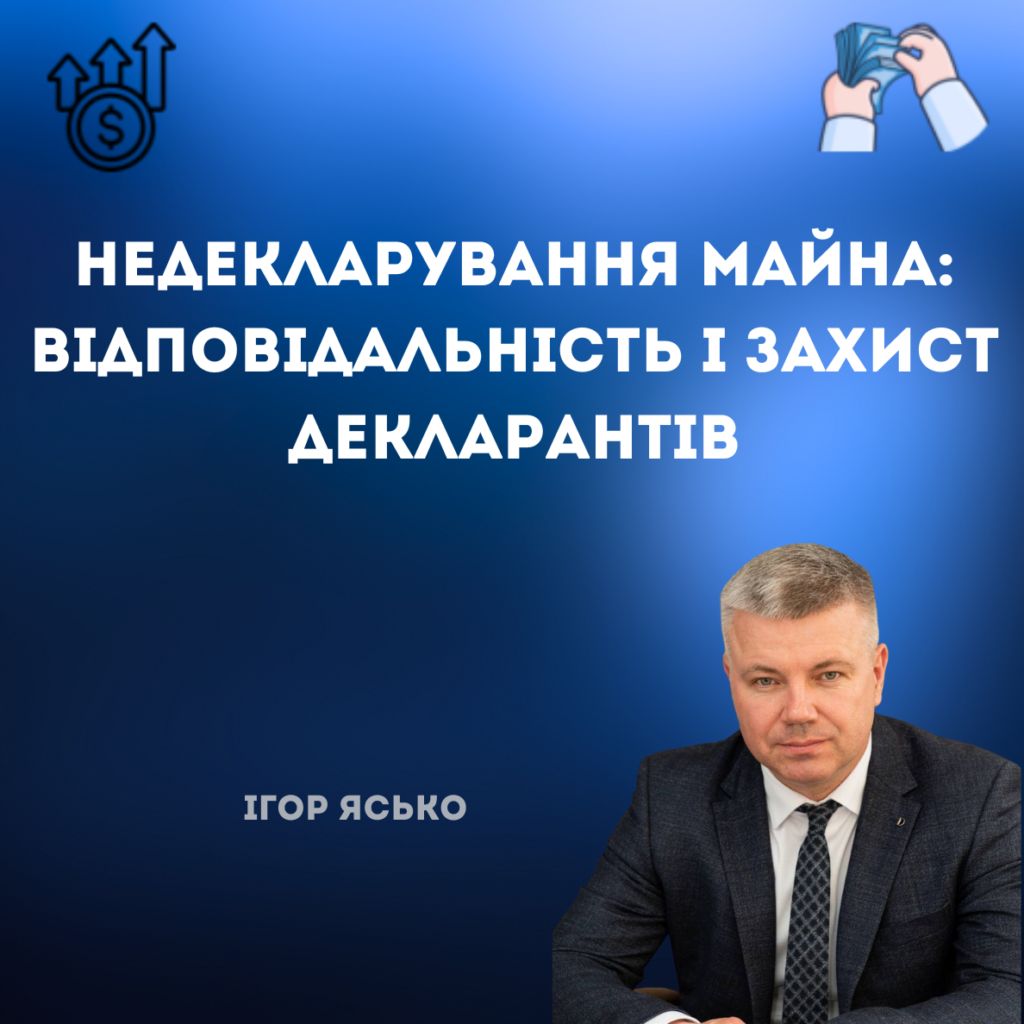
Failure to declare property: liability and protection of declarants

Потрібна допомога адвоката? Залишай заявку During the annual electronic declaration submission period, it is important to remember that errors in declarations can have serious consequences, ranging from criminal liability to reputational damage. This applies not only to ministers and central government officials, but also to local council members, heads of municipal enterprises, local government officials, and other declarants. What practice shows The issue of non-declaration remains relevant. One recent example is the case of a deputy of the Berehove District Council in Zakarpattia. According to the prosecutor’s office, the official did not declare assets and income of more than UAH 8.3 million, including a Ford Mustang and transactions involving the purchase and resale of a Mercedes-Benz S-Class. Such situations arise not only through intent, but also through carelessness or insufficient understanding of legal requirements. However, the law does not distinguish between motives — a mistake can have the same legal consequences as a deliberate violation. Main consequences of non-declaration Criminal liability under Article 366-2 of the Criminal Code of Ukraine — for providing false information or intentionally failing to submit a declaration. Inspections and fines by the NACP and tax authorities. Risk of public scandal and loss of trust among voters or colleagues. Career restrictions — declarants who violate the law are often deprived of the right to hold office in the future. How to prevent problems with the declaration The decisive factor here is not justification after the fact, but legal preparation beforehand. Consulting with lawyers at the stage of preparing the declaration allows you to: correctly classify property, corporate rights, and financial obligations; verify the consistency of income and expenses; avoid incomplete or ambiguous data; warn against the risks of violating anti-corruption legislation. Legal support in the field of declaration is an investment in reputation, not an expense for formality. WINNER: legal protection of transparency The WINNER Law Firm team provides legal assistance to declarants of all levels — from local deputies and civil servants to heads of state and municipal enterprises. We provide comprehensive support for declarations, anti-corruption compliance, and financial transparency, helping you avoid legal risks and protect your integrity. WINNER — when transparency becomes protection. Author: Ihor Yasko, Managing Partner at “WINNER” Law Firm, PhD in Law. https://www.youtube.com/watch?v=4nzvofPywF0

Без рубрики

SSC-2025 for sole proprietors: where you can definitely get into trouble

Потрібна допомога адвоката? Залишай заявку Single Social Contribution (SSC) reporting for simplified‑tax private entrepreneurs for 2025 looks like an «old familiar formality», but after the cancellation of wartime relief it turns into a high‑risk area: an error in the SSC annex may result in fines and loss of insurance record. The main trap is that most sole proprietors have become used to voluntary payments and “zeros”, while in 2025 strict minimum amounts, mandatory deadlines and limited benefits are back in force. What has changed for sole proprietors in 2025Starting from 1 January 2025, SSC payments “for oneself” again became mandatory for all categories of private entrepreneurs, including single‑tax payers; the wartime “voluntary benefit” has been abolished. This means that even in the absence of income an entrepreneur must accrue at least the minimum insurance contribution, unless they belong to a privileged category. The minimum wage in 2025 is 8,000 UAH, so the minimum monthly SSC for a simplified‑tax entrepreneur is 1,760 UAH (8,000 × 22%). At the same time, the maximum assessment base for SSC has been raised to 20 minimum wages, i.e. 160,000 UAH per month, which increases the upper limit of a possible contribution. The trap of SSC minimum and maximumFor simplified‑tax private entrepreneurs, the SSC base “for oneself” must not be lower than the minimum wage and not higher than the statutory maximum; in 2025 this is the range of 8,000–160,000 UAH per month. An incorrect choice of base (for example, below the minimum or “smoothing” the amount unevenly across months) may lead to additional assessments and fines following desk or documentary audits. A separate risk is setting an inflated SSC base “just in case”, when an entrepreneur voluntarily chooses a rate much higher than the minimum without real need. As a result, the entrepreneur overpays a contribution that does not proportionally increase future pension benefits but significantly pressures business liquidity throughout the year. Lost benefits and “special” statusesAfter 2024, the general wartime exemption that allowed a wide range of private entrepreneurs not to pay SSC for themselves no longer applies, which comes as a surprise to those relying on outdated explanations. The right not to pay SSC “for oneself” is preserved only for a narrow list: old‑age or long‑service pensioners, persons with disabilities, and entrepreneurs for whom an employer pays SSC at least at the minimum level. The trap is that the tax authority directly links entitlement to relief either to the fact of minimum SSC being paid by an employer or to an officially confirmed status of pensioner or person with disability. If the employer calculates SSC from a salary below the minimum or the pension/disability documents are not properly formalised, the entrepreneur loses the right to exemption and must pay SSC for themselves. Payment and filing deadlines: the “quarter” riskThe first mandatory SSC payments for January–March 2025 must be made by 21 April 2025, and thereafter according to the general quarterly deadlines for single tax and SSC. Simplified‑tax entrepreneurs who are used to paying “when they have time” risk missing the quarterly payment and incurring interest and penalties even if the annual return with the annex is filed on time. A second‑level trap is failing to understand that SSC “for oneself” is reported in the annual single‑tax return via Annex 1, while the tax authorities monitor it on a monthly basis. If the return shows only a conditional “annual amount” without correct month‑by‑month allocation, the control software may detect gaps in insurance record or “zero” months and create grounds for additional assessments. Annex 1: technical errors that cost service recordFrom 2025, as before, simplified‑tax entrepreneurs report SSC “for themselves” via Annex 1 to the single‑tax return, but attention to correct completion has increased significantly. The annex must correctly indicate each month, the assessment base, the contribution amount, any benefit periods, and mark the status – for example, pensioner, person with disability, or employee under an employment contract. Typical mistakes that cause problems include: missing months (especially during registration or termination periods); simultaneous indication of an SSC base and a status that exempts from payment, which raises suspicion of double counting; incorrect date of acquiring the right to a benefit, because of which the tax service calculates a longer mandatory payment period than the entrepreneur expected. Errors in Annex 1 affect not only penalties: they are reflected in the personalised records of the Pension Fund and may lead to gaps in the insurance history. Correcting such gaps via amended calculations and requests to the Pension Fund is a lengthy bureaucratic process that often becomes an issue at the time of pension assignment rather than when reporting.​ If you are a simplified‑tax entrepreneur: how to avoid the trapTo avoid SSC‑reporting issues for 2025, a simplified‑tax sole proprietor should act systematically rather than on a “leftover” basis. A practical minimum is to: fix a personal calendar of payments and the filing deadline for the return with Annex 1 at the beginning of the year, checking that it matches the schedule for paying single tax and the military levy;​ confirm the presence or absence of benefits (pension, disability, employee status) by obtaining the necessary documents and checking that the employer pays the full minimum SSC for you; choose the SSC assessment base in advance within the minimum‑to‑maximum range, based on the real financial capacity of the business rather than purely “optimistic” projections.​ It is also useful to reconcile SSC amounts paid in 2025 with data in the taxpayer’s e‑cabinet and the Pension Fund to avoid discrepancies before filing the annual return. If errors or omissions are found, it is advisable to submit a correcting Annex 1 and, if necessary, seek professional assistance from a tax consultant or attorney to properly arrange the correction. If you face questions or issues related to correct SSC calculation, completion of Annex 1 or combining entrepreneurial status with employment, your situation should be analysed by specific months and amounts – this will help eliminate risks in time and preserve your insurance record. Author – Yuliia Popadyn,

Без рубрики

Tax social benefit in 2026: in which cases does it apply?

Потрібна допомога адвоката? Залишай заявку The tax social benefit in 2026 is triggered only when three conditions are met simultaneously: the monthly income does not exceed the statutory cap, the employee is entitled to the relevant type of TSB (for themselves or for children), and an application with supporting documents has been filed; entitlement is determined on a monthly basis, so a one‑off excess of the income threshold switches the benefit off only for that particular month. Legal framework and general logicThe tax social benefit is laid down in Article 169 of the Tax Code of Ukraine and applies to the employee’s monthly employment income only at one place of payroll. This means that the TSB is not an “annual discount” but works as a monthly reduction of the PIT base within the prescribed income threshold.The TSB is implemented through the employer acting as a tax agent, who when calculating wages:checks the employee’s application and supporting documents;determines whether the income cap has been exceeded in the relevant month;properly reduces the taxable income by the amount of the benefit and withholds PIT from the “cleaned” base. Key financial parameters for 2026In 2026, the basic TSB amount is UAH 1,664 and the maximum monthly income for its application is UAH 4,660; if the salary (including bonuses and allowances) exceeds this threshold, the benefit is not granted for that month. For “child‑related” benefits, the income cap is multiplied by the number of children under 18 for one parent, and for certain categories (including some persons with disabilities, combatants and single parents) increased TSB amounts of 150% and 200% of the basic level apply. When the TSB is “switched on” during the yearThe right to apply the TSB is determined month by month based on the employee’s actual income rather than an annual average. This has several practical consequences:if in a given month the salary is below UAH 4,660 (or the cap multiplied by the number of children), the TSB applies;if in another month, due to a bonus, allowance or more working hours, the income exceeds the cap, the benefit does not apply only for that month but is not cancelled for the future.The State Tax Service emphasises that exceeding the income cap in one or several months does not deprive the employee of the right to the TSB in subsequent months, provided the income again falls within the allowed limits. Thus, the TSB is triggered every time the monthly salary falls within the corridor that gives the right to the benefit and all other legal requirements are met. Formal conditions: application, documents, place of applicationThe TSB starts to apply from the month in which the employer receives the employee’s application and supporting documents; the application may be filed on any day, and the benefit will still apply for the whole month if the income does not exceed the cap. The TSB can be applied only at one place of employment, so the employee must choose the employer and indicate this in the application; if the tax authority finds that the benefit was used simultaneously with several employers, PIT may be recalculated and additional tax, fines and penalties may be imposed. Typical situations where the TSB actually worksIn practice, in 2026 the TSB most often “works” in the following situations:employees with low wages (fixed‑rate pay, part‑time work, secondary employment) whose monthly income is consistently below UAH 4,660;parents who support two or more children under 18, especially where one parent opts for the child‑related TSB with the multiplied income cap;certain privileged categories (persons with disabilities, combatants, single mothers/fathers) for whom increased TSB amounts are provided, allowing a more significant reduction of the PIT base subject to the income criteria.Specific issues arise in relation to advances and part‑time work: the TSB applies to the total monthly income regardless of the payment schedule, provided the total does not exceed the cap, and in cases of secondary employment or change of employer the employee must ensure that the TSB application is in force with only one tax agent at a time, otherwise the risk of additional assessments increases. If you have any questions or issues related to the tax social benefit in 2026, the procedure for applying it to employees’ wages, determining entitlement to increased or child‑related benefits, recalculating PIT or correcting reporting errors, you should seek professional advice from our specialists, who will help minimise the risk of additional tax assessments and claims from the supervisory authorities.Author – Yuliia Popadyn, attorney of the tax and housing law practice at the Advocates Association “Winner Law Firm”. https://www.youtube.com/watch?v=WU7J13eUo6U

Без рубрики

Where to file the VAT return when changing location

Потрібна допомога адвоката? Залишай заявку Until the end of the current year, the VAT return must be filed with the “old” tax authority, and from 1 January – with the tax authority at the new location, if the controlling authority changes.Legal framework: what to rely onThe rules for linking the return to the “correct” tax office are based on a combination of provisions of the Tax Code of Ukraine (TCU) and the Budget Code of Ukraine (BCU).Key benchmarks:Article 66 of the TCU – procedure for amending taxpayers’ registration data and changing the controlling authority;Article 9 of the TCU – general principles of tax administration, including filing reports at the place of registration;Part 8 of Article 45 of the BCU – payment of nationwide taxes and fees until the end of the budget period at the previous place of registration.This combination of rules leads to the conclusion that the taxpayer remains “linked” to the old budget until year-end, while the transition to the new authority is accompanied by the transfer of both registration and reporting from the new year. Algorithm: where to file the VAT returnA change of location does not always automatically entail a change of tax office or place of filing, so the first step is to determine whether the controlling authority is changing.The basic algorithm is as follows:If the change of location involves a change of administrative district and, accordingly, of the controlling authority, the taxpayer is deregistered at the old address and registered at the new one (para. 66.3 of the TCU, Procedure No. 1588).Regardless of when the re-registration of the VAT payer at the new location actually takes place (even if after deregistration at the old location), the VAT return until the end of the current budget year is filed with the tax authority at the previous location.Starting from 1 January of the following year, the return is filed with the controlling authority at the new location, which becomes the main place of registration.The fiscal position clearly emphasizes that the principle “until year-end – at the old address, from the new year – at the new one” applies even if registration as a VAT payer at the new location takes place after completion of deregistration at the previous location.  Impact of change of location on VAT accountingA change of legal address affects not only where the return is filed, but also the mechanics of VAT accounting and communication with the tax authorities.Key points include:Proper re-registration as a VAT payer must be ensured by submitting a registration application on form No. 1-VAT marked “Re-registration” to the tax authority at the new location once the taxpayer is registered there.During the transition period, the taxpayer is effectively “served” by two authorities: the former one receives returns and ensures VAT payment until the end of the year, and the new one maintains current records, invoice registration and control after the end of the budget period.Incorrectly determining the authority for filing the return may lead to formal violations (late filing or filing to the wrong office), which may result in penalties for non-filing/late filing even if the VAT has in fact been paid. Special situations and risksIn practice, problems most often arise in two groups of situations: when the controlling authority does not change and when registration at the new location is delayed.The following nuances should be taken into account:If the location changes within the same district without changing the controlling authority, only the registration data are updated and the place for filing VAT returns remains the same.If the change of location results in a change of controlling authority and re-registration of the VAT payer at the new address is delayed, VAT reporting and payment are still carried out at the old place of registration until year-end, which is confirmed by the guidance of the State Tax Service and the Generalized Tax Consultations (category 101.24).Typical risks include filing the return immediately with the “new” tax office before the start of the new budget year, lack of reflection of the return in the information systems of the “old” tax office, and disputes over penalties for non-filing. To minimize such risks, it is important to monitor the date of change of location in the Unified State Register and the taxpayer’s status in the VAT Register and coordinate actions with both tax authorities.If you have any questions or issues related to change of location, re-registration as a VAT payer or determination of the competent tax authority for filing VAT returns and paying the tax, please contact the experts of WINNER Law Firm for professional advice. Author: Ihor Yasko, Managing Partner, WINNER Law Firm, PhD in Law. https://www.youtube.com/watch?v=WU7J13eUo6U

Без рубрики

Mandatory vehicle inspection for all cars from 2026: what the Ministry of Development is planning

Потрібна допомога адвоката? Залишай заявку What exactly is the Ministry announcing.  The Ministry for Development of Communities and Territories (often grouped with the infrastructure/transport portfolio) has designated the reform of technical inspection as one of its key legislative priorities for 2026. This is not only about reinstating/expanding vehicle inspections, but about updating an entire package of acts in the field of road transport, carriage of goods and passengers, and road safety. According to statements by the Ministry and sector‑specific media, in 2026 it plans to: gradually introduce mandatory technical inspection for all types of motor vehicles (in practice, for all categories of vehicles, not only trucks and buses as is the case now); reform the inspection procedure, making it simpler, more transparent, and as protected as possible from corrupt abuses. Why the return of inspections became topical.  The return of vehicle inspections has become topical due to Ukraine’s obligation to implement EU law, in particular Directive 2014/45/EU, which treats periodic inspections as a key instrument for monitoring vehicle roadworthiness. The Ministry also stresses safety and environmental goals: extending inspections should reduce accidents caused by technical failures and cut harmful emissions from old or poorly repaired vehicles. Additional motivation is to shrink the shadow transport market and strengthen control over commercial fleets, which are now often operated without proper maintenance. How inspections will be introduced for all vehicle types Inspections will be introduced step by step, not all at once from a single date for every vehicle. The first stage is extending mandatory inspections beyond commercial transport to used passenger cars that: are used in business activities; operate as taxis or delivery services; are part of corporate fleets. The next stage is applying inspections to all passenger cars, including private family vehicles, with different frequency depending on vehicle age (new cars less often, older ones more often, similar to a number of EU countries). In 2025, the rules on technical control were already tightened (photo and video recording, stricter requirements for inspection centres), but this had little impact on private passenger cars. The Ministry declares its intention to cover all types of motor vehicles with inspections, so in 2026 changes are expected to core laws and secondary legislation expanding the list of vehicles subject to periodic technical inspection. How the inspection procedure itself will change.  One of the Ministry’s main stated tasks is to make inspections transparent, standardised, and less prone to corruption. Public statements highlight the following benchmarks: digitalisation of the process: mandatory photo and video recording, electronic recording of results, and integration with vehicle and insurance registers; unification of requirements for inspection centres, including equipment, access to databases, staff qualifications, and a system for granting and revoking accreditation; introduction of stricter defect‑assessment standards modelled on European practice (critical, major, minor deficiencies) and linking inspection results to whether a vehicle may be operated. In parallel, the Ministry plans to update the rules for transporting dangerous goods and to create a National Transport Accident Investigation Bureau for deeper analysis of road accident causes. This underlines that inspections are not a fiscal tool but part of a broader, integrated transport safety policy. Implications for drivers and business.  The return of mandatory inspections will mean regular time and financial costs for drivers, but also clearer rules: without a valid inspection, a vehicle may not be operated. The actual frequency and cost for different transport types will only be defined after the laws are adopted, so in 2026 it will be important to follow official clarifications by the Ministry and the government. For businesses (carriers, logistics operators, taxi services, corporate fleets), inspections from 2026 onward will mean stricter requirements for vehicle roadworthiness, the need for scheduled maintenance, and updates to internal safety policies. At the same time, a digital, transparent control system may reduce the number of purely formal checks and corruption risks and become a competitive advantage for companies that invest in proper vehicle condition and compliance. If you have questions or issues related to preparing for inspections, challenging inspection results, or fines for vehicle technical condition, you should seek qualified legal advice from Attorneys Union “LAW COMPANY ‘WINNER’”. Author: Ihor Yasko, Managing Partner at Attorneys Union “LAW COMPANY ‘WINNER’”, PhD in Law. https://youtu.be/BL8jBRRsSTI?si=EW0CFAGwP8GcU4Bk

Без рубрики

“Business splitting”: when optimization turns into tax evasion

Потрібна допомога адвоката? Залишай заявку The issue of the legality of tax optimisation lies on the borderline between business efficiency and the risk of liability, and one of the most debated tools has become “business splitting”, meaning the formal division of a single process between several legal entities or individual entrepreneurs (sole proprietors) in order to benefit from the simplified taxation system.​Essence and motives of “splitting”The typical purpose of such actions is to reduce the tax burden by: using the simplified taxation system (a single tax instead of corporate income tax and VAT); avoiding turnover limits; reducing payroll‐related charges; simplifying accounting and organisational record‑keeping.​ For example, a large restaurant registers several waiters and bartenders as “individual entrepreneurs” who ostensibly provide services independently. In reality, they work exclusively at one venue, in the same premises, under a single management team. Formally, this is a set of independent sole proprietors; in substance, it is a classic case of business splitting.​ Position of the tax authorities and court practiceThe State Tax Service of Ukraine (STS) has repeatedly emphasised in its guidance that the artificial creation of several sole proprietors or interrelated legal entities, where they operate with the sole purpose of avoiding taxes, may be treated as tax evasion. The key focus of the fiscal authorities is not the number of entities but the existence of a single business process, centralised management, a common customer base, personnel or assets.​ Court practice on this matter is gradually developing. The Supreme Court, in a number of decisions, has supported the tax authorities where it was proven that: business transactions between related structures were fictitious or had signs of artificiality; the entities had no genuine business purpose other than reducing the tax burden; control over several entities was exercised by one individual or a group of individuals through family or employment ties.​ It is precisely the combination of such indicators that allows the splitting scheme to be qualified as an abuse of rights.​ Thin line between lawful optimisation and evasionOptimisation is regarded as legitimate where business entities: have their own business purpose and economic independence; are not under a single centralised management; keep separate accounts and possess their own assets, staff and clients; were not created solely to reduce taxes.​ Conversely, the indicators of evasion include: duplication of functions between entities; shared offices, assets, bank accounts or logistics; understatement of turnover due to limits applicable to the simplified system; using relatives or subordinates as nominal owners of sole proprietorships.​ Thus, the line of legality lies not in the formal structure of the business but in the substance of the relationships and the economic logic of the operations.​ Why the risks are increasing nowAfter 2023, with the launch of modern analytical tools of the STS (“Tax Block”, “E‑cabinet”, etc.), it has become much easier to identify links between entities. The system analyses: common IP addresses, registration addresses and managers; identical suppliers or customers; synchronous transactions on bank accounts; recurring patterns in staff arrangements.​ Consequences of a scheme being treated as evasionIf the tax authorities prove that splitting is artificial in nature, the business may face: additional tax assessments (VAT, corporate income tax, unified social contribution); penalties for tax offences; loss of the single‑taxpayer status under the simplified system; criminal liability under Article 212 of the Criminal Code of Ukraine for tax evasion.​ In addition, managers risk attracting the STS’s attention during future audits of other structures personally connected with them.​ How to mitigate the risksTo minimise risks, lawyers recommend: conducting an internal audit of the business structure and assessing the economic rationale for establishing each entity; executing genuine intercompany contracts on arm’s‑length terms; separating management chains so that each entity has its own managers, hiring, warehouses and financial reporting; maintaining an evidence base of real operations (acts of acceptance, certificates of completed works, independent procurement, etc.); in case of doubt, obtaining an individual tax ruling, which may help avoid sanctions in the future.​ ConclusionBusiness splitting is not a crime per se. However, when “optimisation” turns into an artificial construct without economic substance, it loses legal protection and becomes a violation. In today’s environment, where tax authorities have access to large volumes of data, the entrepreneur’s main task is to preserve the transparency, logic and reality of the business model.​ If you have questions or issues related to your business structure, tax audit risks or the classification of transactions as “business splitting”, contact our team’s experts — we will help protect your interests at every stage.Author: Ihor Yasko, Managing Partner, WINNER Law Firm, PhD in Law. https://youtu.be/BL8jBRRsSTI?si=QwWPFwKhMeykowTe

Без рубрики

Refusal to undergo a medical examination under Article 130 of the Code of Administrative Offenses: liability regardless of the state of intoxication

Потрібна допомога адвоката? Залишай заявку A driver’s refusal to undergo an examination for intoxication in a medical facility, proposed by a police officer in the prescribed manner, in itself constitutes an administrative offence under Article 130 of the Code of Ukraine on Administrative Offences and does not depend on whether the driver was actually under the influence of narcotic (or other) substances. The driver’s references to the absence of signs of intoxication or a subjective belief in being sober do not release him or her from liability if a proper refusal to undergo the examination has been recorded. Legal framework: Article 130 of the Code of Administrative Offences and clause 2.5 of the Traffic RulesArticle 130 provides for liability not only for driving while intoxicated, but also for refusing to undergo the prescribed examination, the obligation for which is expressly set out in clause 2.5 of the Traffic Rules. Such refusal is an independent offence and, in terms of consequences, is equated to driving while intoxicated because of its high public danger. Refusal as an independent offence: key focuses of court practiceCourts consistently state that a driver’s refusal to undergo an examination for intoxication is an independent ground for administrative liability, regardless of the person’s actual sobriety. What matters legally is the failure to comply with a lawful demand of the police officer, not the outcome of a potential medical examination. Courts of appeal stress that what must be proven is the existence of a lawful demand, compliance with the procedure for presenting it, and the recorded refusal, rather than the driver’s medical condition. Therefore, the argument “I was sober, so I did not have to undergo the examination” is not recognised as legally relevant for exemption from liability. Type of intoxication does not affect qualification of refusalCourts of appeal indicate that where a driver refuses to undergo an examination, the type of possible intoxication (alcohol or drugs) is irrelevant for qualification under part 1 of Article 130. What is incriminated is the breach of clause 2.5 of the Traffic Rules – refusal to undergo the examination in the prescribed manner, even if there is a suspicion of narcotic rather than alcohol intoxication. This approach is intended to prevent abuses where drivers try to manipulate the difference between types of intoxication to avoid the examination procedure. Significance of a driver’s explanations about “no signs”Drivers often state in their explanations that they had no signs of intoxication and therefore considered the examination unfounded and refused it. However, case law consistently proceeds from the premise that a driver’s subjective assessment of his or her own condition, as well as references to the absence of external signs of intoxication, cannot substitute the results of a medical examination or undermine the mandatory nature of complying with a lawful police demand.The driver’s explanations are relevant only as one item of evidence, which is assessed together with other materials in the case: video recordings, reports, witness statements, examination reports and police memoranda. Such explanations alone do not constitute a ground for closing the proceedings if there is proper evidence that the refusal did occur and was duly recorded. When there is no offenceLiability for refusal to undergo an examination is possible only if the fact of driving a vehicle by a specific person is proven. If the case file contains no proper evidence that the person was driving (such as video recordings, witness statements, etc.), courts annul decisions issued under Article 130 of the Code of Administrative Offences. Refusal to undergo an examination alone does not constitute the offence without a proven fact of driving; the full offence arises only when there is a body of evidence of driving and a properly documented refusal.​ Procedural requirements for recording refusalFor lawful liability for refusal to undergo an examination, the police must comply with the prescribed procedure: the refusal must be clear, unambiguous and properly recorded – preferably on video, or, if there is no video, in the presence of two witnesses with appropriate entries in the report. The examination must be proposed in the manner provided by law, with an explanation of the right to be examined using technical devices or in a medical facility and with observance of the route, timing and form of documents; material breaches of these requirements (no video or witnesses, errors in the report) often serve as grounds for cancelling the decision and closing the proceedings. Takeaways for drivers and lawyersModern case law confirms that a duly recorded refusal to undergo an examination for intoxication in a medical facility constitutes a completed administrative offence under Article 130, regardless of the driver’s actual condition. References to the absence of signs of drug or alcohol intoxication, ignorance of the law or a personal belief in one’s sobriety do not release a person from liability if he or she has failed to fulfil the obligation to undergo an examination in the manner prescribed by law.At the same time, defence in such cases is possible and often successful where procedural violations by the police are documented: failure to prove the fact of driving, lack of proper recording of the refusal, mistakes in the reports or non-compliance with the requirements for sending the person to a medical facility. It is the analysis of evidence, videos, reports and compliance with formal requirements that becomes the key tool for a lawyer when appealing decisions under Article 130.If you have any questions or issues related to liability for refusal to undergo an examination for intoxication, the drawing up of reports, challenging decisions or developing a defence strategy under Article 130, it is advisable to seek qualified legal assistance as soon as possible in order to assess the evidence, choose the right tactics and minimise the risk of administrative sanctions. Author: Yevhenii Murchenko, Head of the Criminal Law and Procedure Practice of the law firm “WINNER”. https://youtu.be/S9C2nn5VO0I?si=o6m_qgq_f-YrZfsh

Без рубрики

Tymoshenko – bail set at 33 million

Потрібна допомога адвоката? Залишай заявку The court emphasized that a preventive measure may be applied only where specific risks are proven, and not because of the publicity of the case or the person’s status.​ In matters of preventive measures, the court always assesses not the person and not the public background of the case, but the presence of specific risks provided for by the Criminal Procedure Code.​In this case, the prosecution insisted on applying a preventive measure, referring to the seriousness of the alleged acts, the public status of the person and the possibility of influencing the course of the proceedings.​However, these arguments were general in nature and were not supported by specific facts demonstrating the reality of such risks.​The defence drew the court’s attention to the person’s procedural conduct, the absence of any actions aimed at obstructing the investigation, as well as the existence of stable social ties.​ When making its decision, the court proceeded from the following:risks must be proven, not presumed;the person’s status alone is not a ground for restricting his or her rights;a preventive measure must be proportionate and necessary specifically for the purposes of the criminal proceedings.​ The court also separately stressed that a preventive measure cannot be used as a form of preliminary punishment.​Thus, the decision was taken with due regard to the balance between the interests of the investigation and the rights of the person, without going beyond procedural standards.​ If you have any questions or issues, it is advisable to seek individual legal advice in order to assess your risks and protect your rights.​Author: Ihor Yasko, Managing Partner of the law firm “WINNER”, PhD in Law. https://youtu.be/Kryko4lTfmo?si=1bSAfp0LVmIdKrsS

Scroll to Top